Now is Yoga Time → Asana Compendium → Backbend Asanas
Backbend Asanas
Backbends are the quiet art of opening — not a push into intensity, but a gradual softening of the front body and a steady awakening of the back. These shapes invite you to explore space where the body often feels closed or protected. As the chest expands and the spine lengthens, breath begins to move with more freedom, creating a sense of spaciousness that feels both grounding and uplifting.
In Backbends, the back body strengthens while the front body softens. The heart space lifts, the ribs widen, and the spine learns to extend with integrity rather than force. These poses reveal how openness is not created by bending deeply, but by cultivating stability, awareness, and a willingness to meet sensation with patience.
Over time, Backbends become a practice of courage — not the loud kind, but the quiet, steady courage of staying present with vulnerability, expansion, and the unfamiliar. They remind you that opening is a process, not a destination, and that strength and softness can coexist in the same breath.
This is the practice of spaciousness — grounded, attentive, and gently transformative.
What Backbends Teach
Backbends teach you how to open without collapsing, how to strengthen without hardening, and how to breathe into spaces that feel tight or guarded. They reveal the relationship between the front and back body — how one supports the other, how stability creates room for expansion, and how breath can guide the spine into deeper clarity.
These shapes also cultivate emotional awareness. Backbends often bring energy to the surface, inviting you to meet whatever arises with steadiness and compassion. They teach you to stay grounded even as you open, to remain connected to the earth even as the chest lifts toward the sky.
Key Benefits
- Strengthen the back, glutes, and posterior chain
- Open the chest, shoulders, and hip flexors
- Improve spinal mobility and posture
- Increase breath capacity and rib expansion
- Energize the body and uplift mood
- Balance the effects of sitting and forward‑folding patterns
- Build confidence, resilience, and emotional openness
Common Mistakes
- Compressing the lower back instead of lengthening the spine
- Forcing the chest upward without grounding the legs
- Over‑tightening the glutes or gripping the shoulders
- Holding the breath during the lift
- Collapsing the neck or dropping the head back too quickly
- Ignoring the role of the core in stabilizing the shape
How to Approach Backbends
Move slowly and with curiosity.
Begin with grounding — feet, legs, and pelvis stable.
Let the spine lengthen before it arcs.
Open the chest gradually, allowing breath to guide the expansion.
Use props or variations to support the shape without strain.
Backbends are not about depth; they are about clarity, integrity, and ease.
Asanas in This Category
(Each name will be a link to an individual Asana page)
- Bhujangasana — Cobra Pose
- Urdhva Mukha Svanasana — Upward‑Facing Dog
- Salabhasana — Locust Pose
- Dhanurasana — Bow Pose
- Ustrasana — Camel Pose
- Setu Bandhasana — Bridge Pose
- Urdhva Dhanurasana — Wheel Pose
- Anjaneyasana — Low Lunge Backbend
- Matsyasana — Fish Pose
- Supta Virasana — Reclining Hero Pose
- Laghu Vajrasana — Little Thunderbolt Pose
Recommended Mini‑Sequences
Gentle Heart Opening (3 minutes)
Cobra → Sphinx → Child’s Pose → Cobra
Strength & Expansion (5 minutes)
Locust → Upward‑Facing Dog → Camel → Child’s Pose
Backbend Flow (4 minutes)
Low Lunge Backbend → Bridge → Fish Pose → Rest
Clips
A short video guide will be posted here in the future.
Backbends
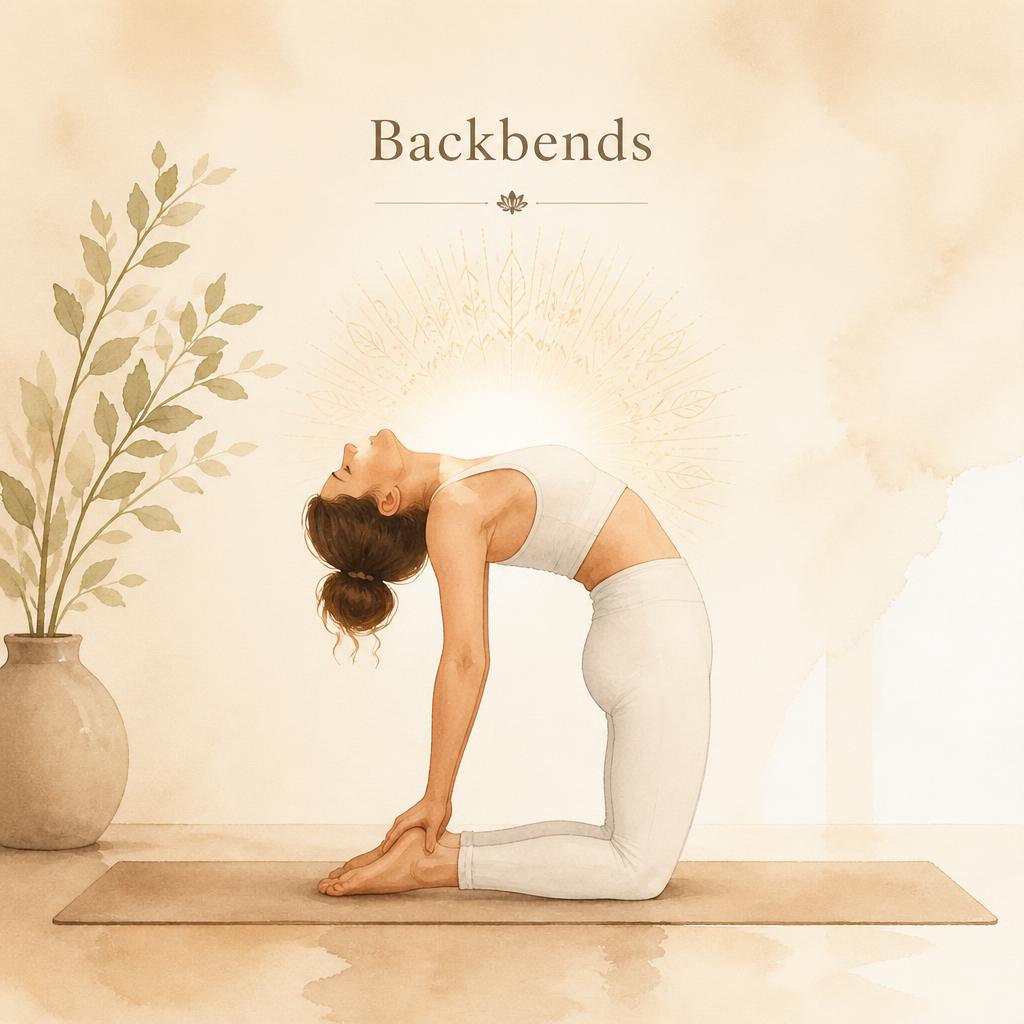
Backbends open the front body with a sense of spaciousness and awakening. These poses strengthen the back, expand the chest, and invite a deeper, more vibrant breath. Practiced with steadiness and care, backbends energize the entire system — they counterbalance the forward‑folding patterns of daily life and help restore natural posture. As the heart space lifts, the spine lengthens and the body learns to support itself with integrity rather than force. Backbends are both grounding and uplifting: they build resilience, encourage courage, and create a gentle feeling of openness from the inside out.