Now is Yoga Time → Asana Compendium → Restorative & Yin Asanas
Restorative & Yin Asanas
Restorative & Yin Asanas invite you into a different rhythm — one that moves beneath effort, beneath ambition, beneath the need to achieve. These shapes are slow, spacious, and deeply nourishing. They ask nothing from you except presence. In this stillness, the body unwinds, the breath softens, and the nervous system begins to settle into a quieter, more receptive state.
Unlike active practice, Restorative & Yin do not seek to strengthen or energize. They create room — in the joints, in the breath, in the mind. The poses are held for longer, allowing gravity to do the work while the body gradually releases layers of tension stored in the connective tissues. This slow unfolding reveals a different kind of intelligence: one that emerges only when you stop pushing and start listening.
Over time, these shapes become a refuge. A place where you can rest without expectation, soften without fear, and reconnect with the subtle, grounding qualities of stillness. Restorative & Yin remind you that healing often happens in the quiet moments — when the body feels safe enough to let go.
This is the practice of deep rest — soft, spacious, and profoundly restorative.
What Restorative & Yin Teach
Restorative & Yin teach patience, surrender, and the art of doing less. They show you how to meet sensation with softness, how to breathe into stillness, and how to trust the natural unfolding of the body without forcing change.
These shapes reveal the relationship between breath and the parasympathetic nervous system — how slowing down creates space for healing, clarity, and emotional release. They also cultivate a gentle awareness that is not analytical, but felt: a quiet presence that deepens with each breath
Key Benefits
- Calm the nervous system and reduce stress
- Release deep tension in fascia and connective tissues
- Improve joint mobility and circulation
- Support emotional regulation and grounding
- Enhance breath awareness and relaxation
- Promote deep rest and recovery
- Create space for introspection and quiet presence
Common Mistakes
- Forcing the body deeper instead of allowing gravity to guide the shape
- Holding the breath during intense sensations
- Collapsing into joints without proper support
- Rushing the transitions between poses
- Ignoring props that could create comfort and safety
- Treating the practice as “stretching” rather than softening
How to Approach Restorative & Yin
Move slowly, as if entering a sacred space.
Use props generously — blankets, bolsters, blocks, cushions.
Let the breath be soft, natural, unhurried.
Allow the body to settle without expectation.
Stay present with sensation, but without pushing.
Restorative & Yin are not about depth — they are about ease, safety, and surrender.
Asanas in This Category
(Each name will be a link to an individual Asana page)
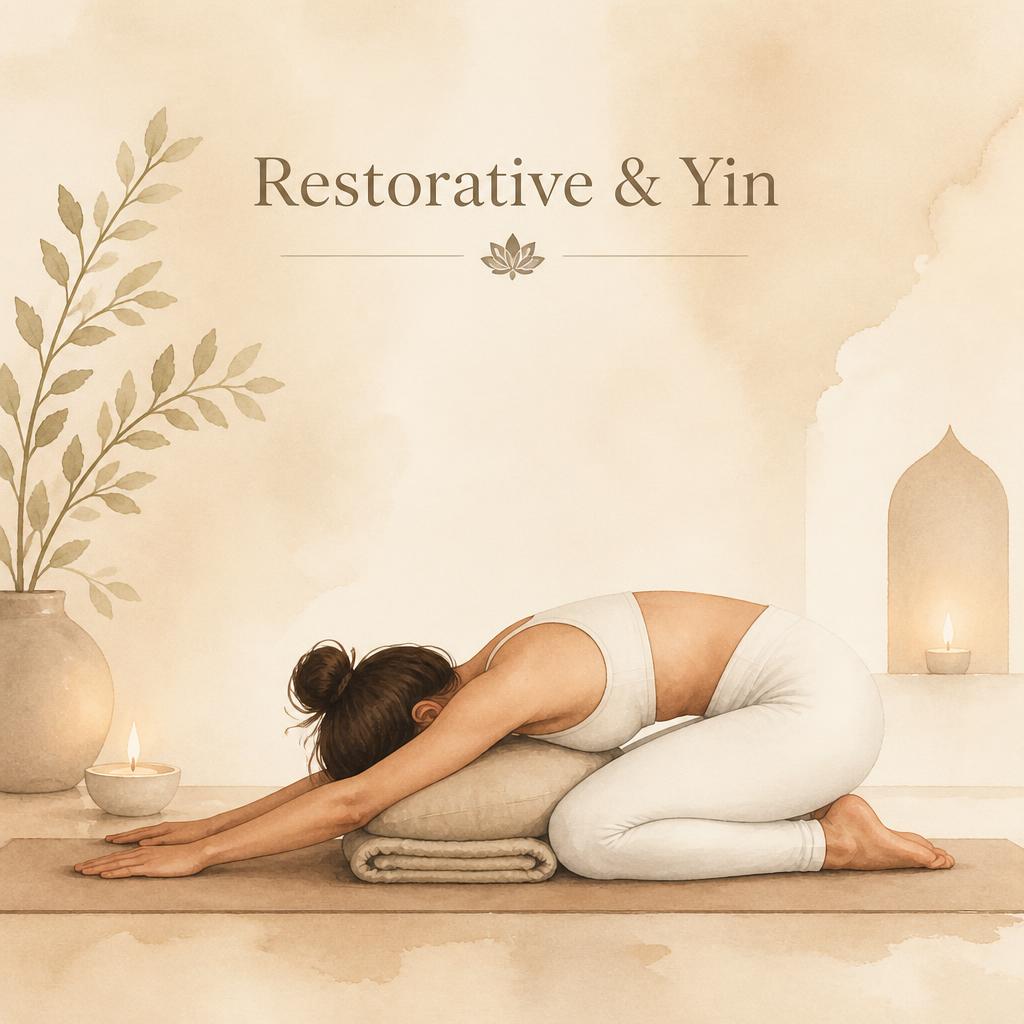
- Balasana (Supported) — Supported Child’s Pose
- Supta Baddha Konasana — Reclining Bound Angle
- Viparita Karani — Legs Up the Wall
- Supported Bridge — Setu Bandha Variation
- Caterpillar Pose — Yin Forward Fold
- Dragon Pose — Yin Lunge
- Sphinx Pose — Yin Backbend
- Seal Pose — Yin Backbend Variation
- Butterfly Pose — Yin Hip Opener
- Reclined Twist — Supported Supine Twist
- Restorative Savasana — Fully Supported Rest
Recommended Mini‑Sequences
Nervous System Reset (3 minutes)
Supported Child’s Pose → Reclined Twist → Rest
Deep Hip & Spine Release (5 minutes)
Butterfly → Caterpillar → Supported Savasana
Evening Wind‑Down (4 minutes)
Legs Up the Wall → Supported Bridge → Rest
Clips
A short video guide will be posted here in the future.