How to Return to Yourself in 30 Seconds
There are moments when life feels too fast — not because the world is rushing, but because something inside you has lost its rhythm. Your breath becomes shallow. Your thoughts scatter. Your body tightens in places you don’t notice until much later.
And yet, the return is always closer than it seems.
This reflection is part of the larger theme explored in Presence as a Daily Practice, where I write about presence as a way of living.
Presence doesn’t require a quiet room, a meditation cushion, or a perfect morning. It requires only one thing: a willingness to pause. A willingness to feel. A willingness to come back to the place where your life is actually happening — here, in this breath, in this body, in this moment.
This is the art of returning to yourself. And it can begin in less than 30 seconds.
The Moment You Notice You’re Gone
We all drift away from ourselves. Into thoughts. Into tension. Into autopilot. Into the endless momentum of doing.
The moment you notice you’re gone is not a failure. It is an invitation.
Awareness is not the end of presence — it is the beginning.
When you catch yourself rushing, tightening, or disconnecting, you are already halfway home. The noticing itself is a doorway. You don’t need to analyze it. You don’t need to fix it. You don’t need to understand why it happened.
You only need to step through.
A 30‑Second Return (The Practice)
Here is a simple, gentle practice you can use anywhere — in the kitchen, in the car, during a conversation, between emails, or in the middle of a difficult moment.
1. Pause for one breath.
Not a long pause. Just one breath that is yours.
Let the world continue without you for a moment. Let your shoulders soften, even slightly.
2. Exhale slowly.
The exhale is the body’s natural release. It signals safety. It widens the space inside you.
Feel the breath leave your body. Feel the weight of your chest settling.
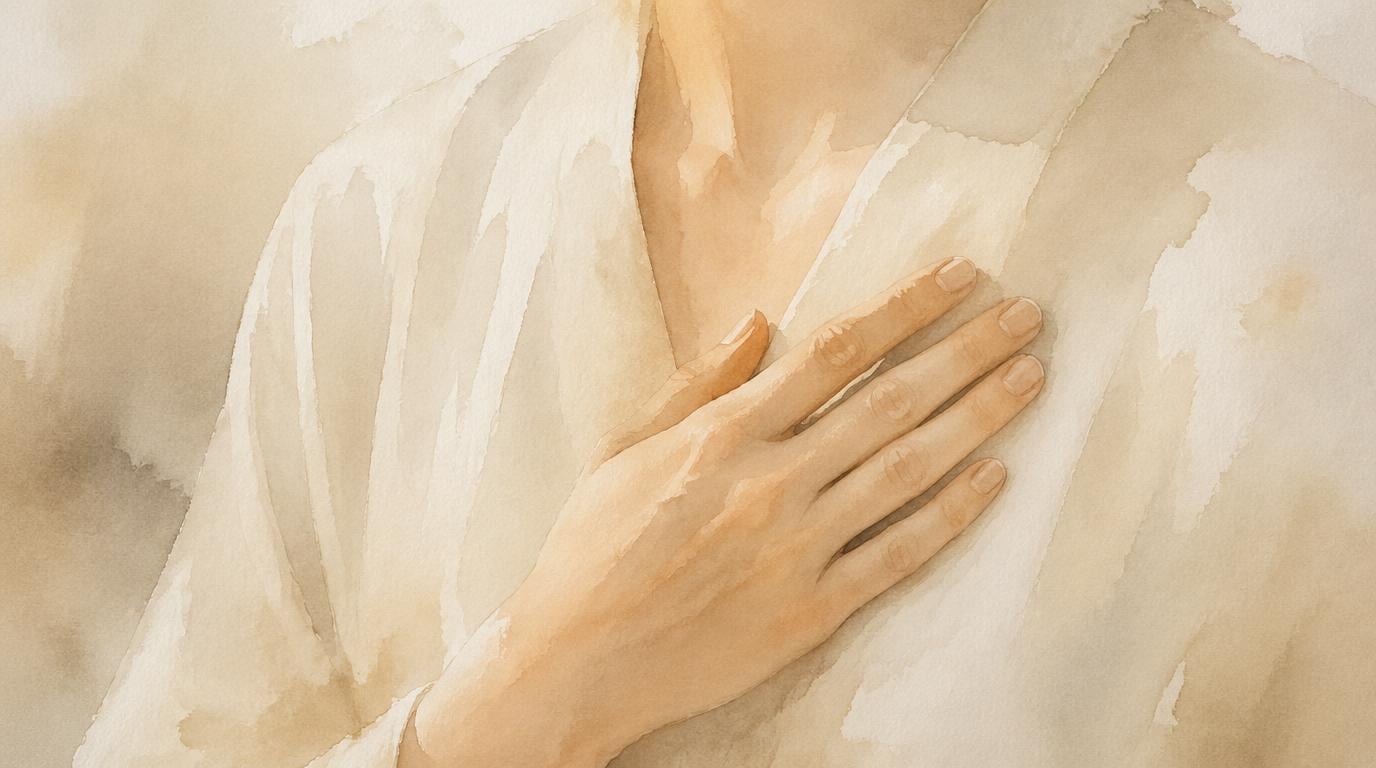
3. Place one hand on your body.
Your chest. Your belly. Your heart. Your ribs.
This touch is not symbolic — it is somatic. It brings your awareness from the mind into the body, from thinking into feeling.
4. Notice one sensation.
Warmth. Movement. Tension. Softness. The pulse beneath your palm.
You don’t need to change the sensation. Just feel it.
5. Let the moment be enough.
Presence is not about achieving a state. It is about meeting what is here.
This is the return. Simple. Human. Available.
Why This Works (The Nervous System Behind It)
This practice is short, but it is not shallow. It works because it speaks the language of the nervous system.
- The pause interrupts autopilot.
- The slow exhale activates the parasympathetic system — the body’s natural calming response.
- The hand on the body creates a grounding somatic anchor.
- The sensation brings you into direct experience instead of mental narrative.
You are not “trying to be present.” You are creating the conditions in which presence naturally appears.
Presence is not something you force. It is something you allow.
Returning to Yourself in Daily Life
The beauty of this practice is that it fits into the smallest spaces of your day.
You can use it:
- before opening your laptop
- while waiting for water to boil
- after receiving a message that tightens your chest
- when you feel overwhelmed
- when you feel disconnected
- when you want to begin again
Presence is not a grand event. It is a series of small returns.
Every return strengthens the pathway home. Every return softens the edges of your day. Every return reminds you that you are here — living, breathing, sensing, becoming.
Presence Is a Relationship
Presence is not a skill you master. It is a relationship you cultivate.
A relationship with your breath. A relationship with your body. A relationship with the moment you are in.
And like any relationship, it grows through small gestures — the quiet, consistent ones that say:
“I am here.” “I am listening.” “I am returning.”
You don’t need to be present all the time.
You only need to return.
Again and again.
Gently.
If you want to explore the foundations of conscious living more deeply, you can download my free ebook Yama & Niyama. It’s a soft, practical introduction to presence, simplicity, and inner alignment.