Now is Yoga Time → Asana Compendium → Forward Fold Asanas → Uttanasana
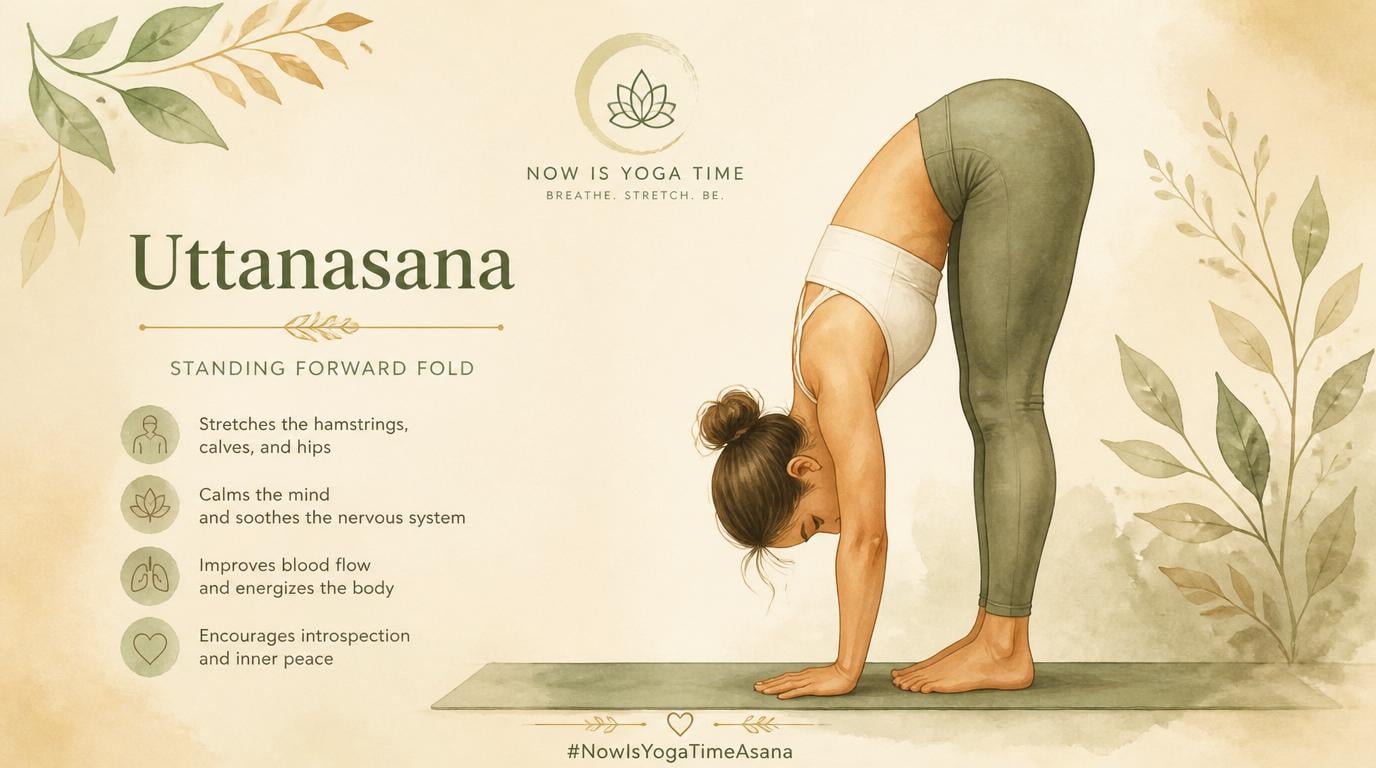
Uttanasana – Standing Forward Fold
The art of surrendering downward — releasing the back body, quieting the mind, and returning to ease.
Introduction
Uttanasana invites the body into surrender. It is a quiet folding inward — a gesture of letting go that reaches far deeper than the hamstrings. In Standing Forward Fold, we learn to yield: to gravity, to the breath, to the natural intelligence of a body that knows how to release when given permission.
This posture appears simple. You fold forward. You hang. You breathe. But within that simplicity lives a profound practice of softening habitual tension — in the spine, the neck, the back of the legs, and the nervous system itself. Uttanasana is one of the few poses that simultaneously stretches the entire back body while calming the mind. The inversion of the head below the heart slows the heart rate, quiets mental chatter, and offers a moment of genuine stillness.
Whether held briefly in a Sun Salutation or explored slowly in a standing sequence, Uttanasana teaches us that release is not weakness. It is wisdom. This pose welcomes all levels — beginners and experienced practitioners alike find something new here each time they return.
What is Uttanasana?
Uttanasana (oo-tah-NAH-sah-nah) comes from the Sanskrit ut — intense, tan — to stretch, and asana — posture. It translates as Intense Stretch Pose, though it is widely known as Standing Forward Fold.
It is a standing forward bend — foundational in Hatha yoga, present in every Sun Salutation, and used as a transitional and restorative pose throughout most yoga sequences. Uttanasana follows naturally from Tadasana and precedes Ardha Uttanasana (Half Forward Fold) or Plank in flowing practice.
The quality Uttanasana cultivates is surrender — the willingness to fold inward, to let the head drop below the heart, and to release the constant effort of holding oneself upright. (I write about this quality more in Presence as a Daily Practice) It is both grounding and calming: rooted through the feet, released through the spine, quieted through the nervous system.
Uttanasana belongs to the category of Standing Asanas as well as Forward Fold Asanas. Here on Now is Yoga Time, I keep it in the category of forward fold.
Anatomy
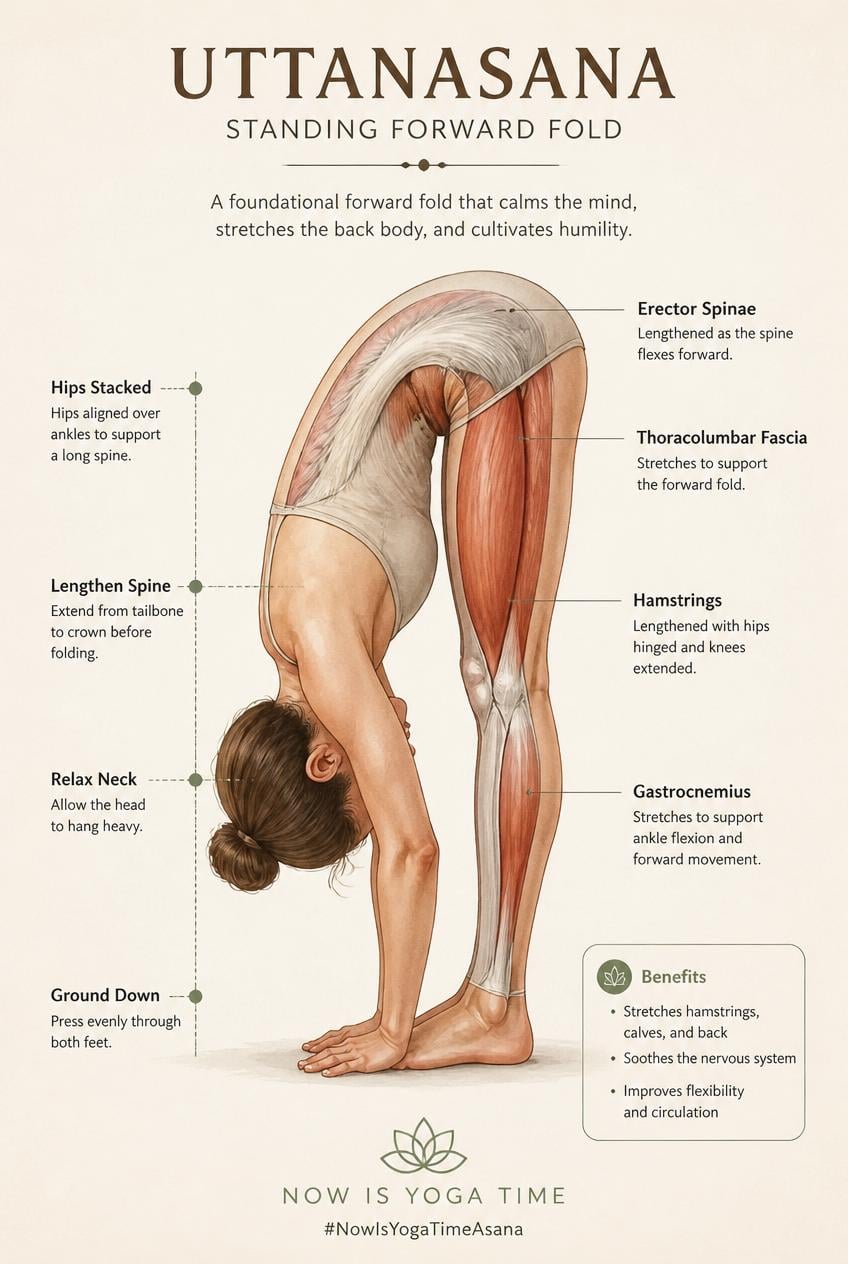
Uttanasana engages and lengthens the entire back body:
- Feet and ankles — grounding, weight distribution, arch support
- Hamstrings (biceps femoris, semitendinosus, semimembranosus) — primary stretch, eccentric lengthening
- Gastrocnemius and soleus — calf lengthening, especially with active feet
- Gluteus maximus — lengthening as the pelvis tilts anteriorly
- Erector spinae and multifidus — decompression and gentle traction along the spine
- Quadratus lumborum — release of chronic lower back tension
- Thoracolumbar fascia — broad myofascial release through the entire back
- Posterior neck muscles (semispinalis, splenius) — release as the head hangs freely
- Hamstring attachments at the sit bones — gradual opening with sustained hold
The pose integrates gravity as a teacher: the deeper the release, the more the entire back body opens — from heel to skull — in one continuous line of sensation.
Technique — Step by Step
- Begin in Tadasana (Mountain Pose) — feet hip-width apart or together, weight evenly distributed.
- Inhale — lengthen the spine upward, creating space between each vertebra.
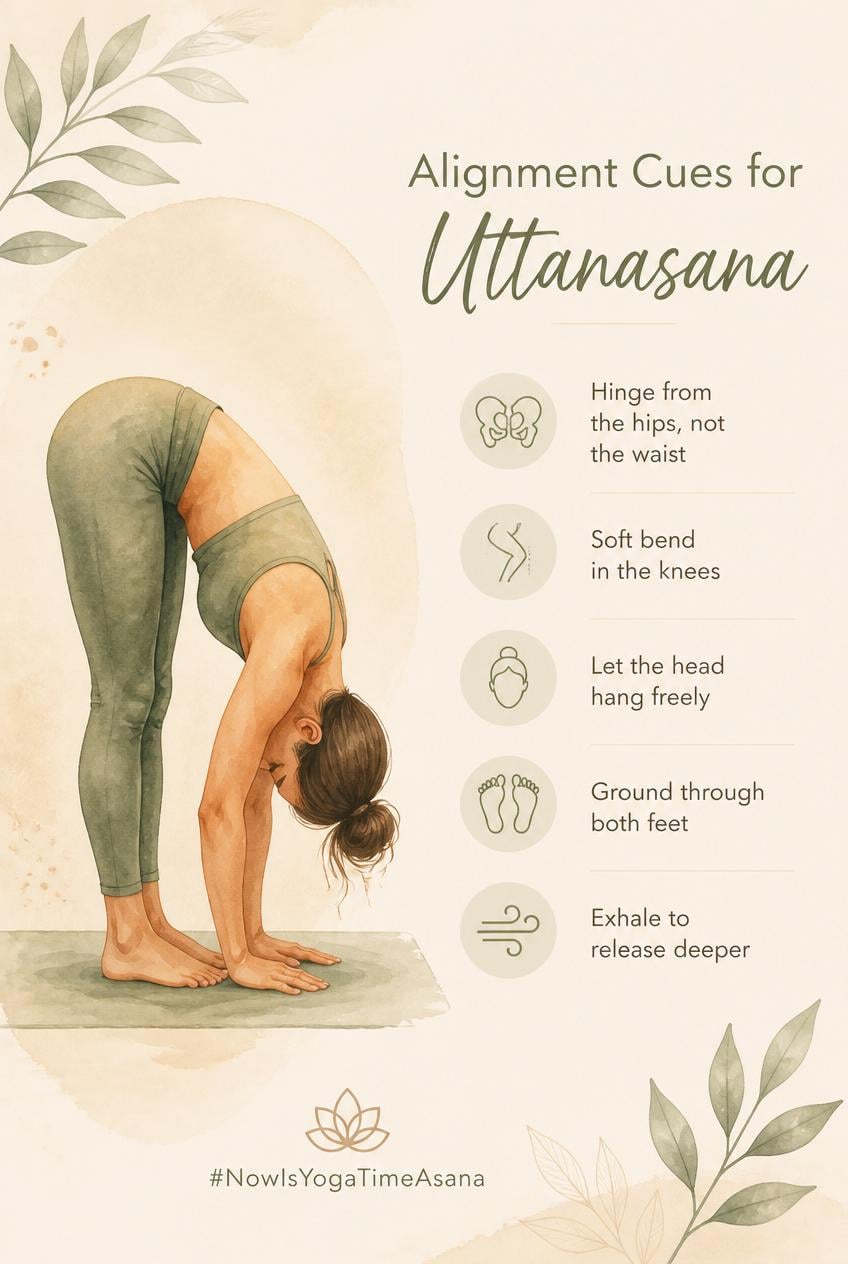
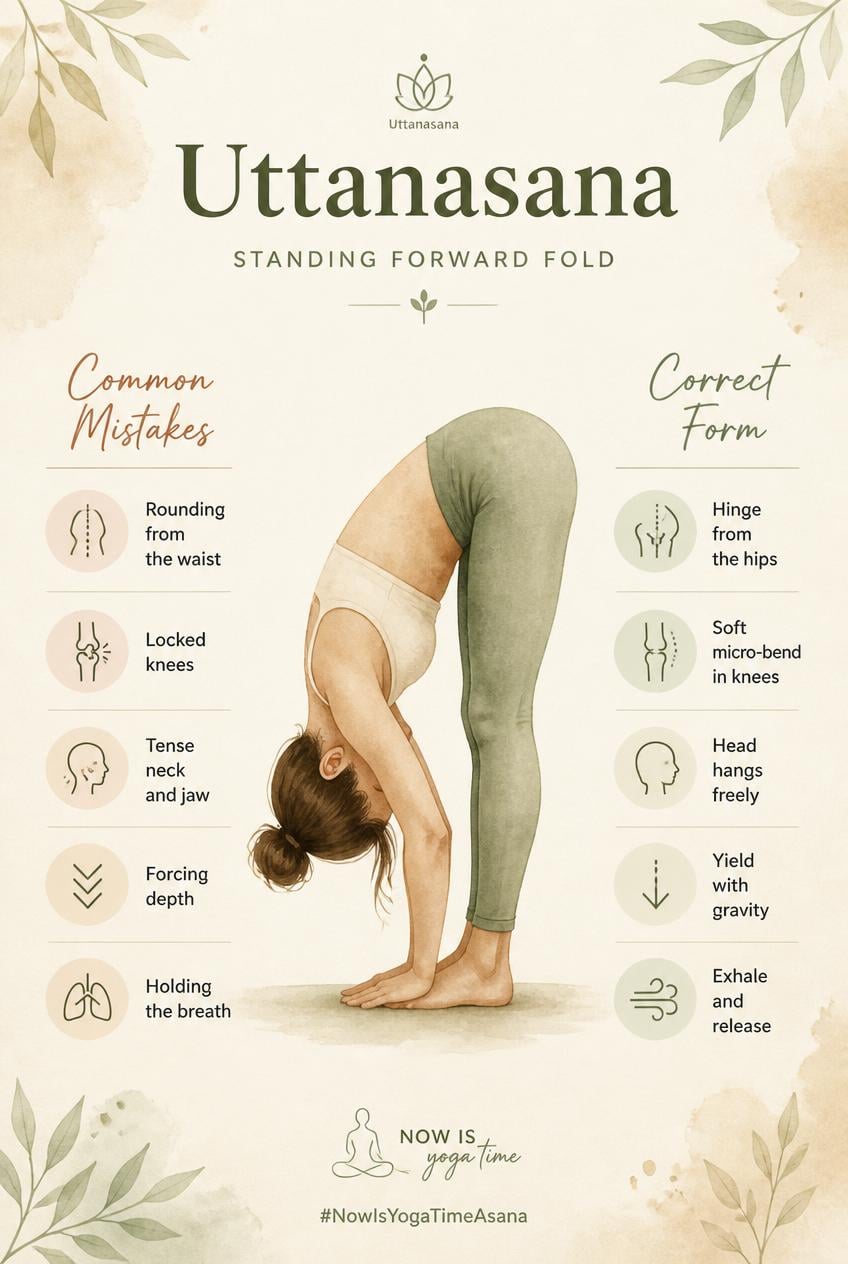
- Exhale — hinge forward from the hips, not the waist. Let the pelvis tilt anteriorly as the torso descends.
- Keep a soft micro-bend in the knees, especially if the hamstrings are tight. The knees are never locked.
- Allow the hands to rest on the floor, fingertips, or shins — wherever feels natural without forcing.
- Let the head hang completely. Release all effort in the neck. The crown of the head reaches toward the earth.
- With each inhale, feel the back body expand gently.
- With each exhale, allow the torso to soften a little deeper — not through force, but through release.
- Keep the feet grounded and the thighs gently engaged to protect the knee joints.
- Optional: clasp opposite elbows and let the arms swing gently to release the shoulders and upper back.
- Hold for 5–10 slow breaths, cultivating the quality of surrender with each exhale.
- To exit: place hands on hips, engage the core gently, and rise on an inhale — vertebra by vertebra — back to Tadasana.
Bandhas & Drishti
Drishti — Nasagrai (nose gaze) or free: In Uttanasana, the head hangs freely and the gaze naturally falls toward the knees or rests inward. There is no fixed drishti required here — instead, soften the eyes completely and allow the gaze to turn inward. This supports the parasympathetic quality of the pose.
Mula Bandha — Root Lock: A gentle engagement of the pelvic floor helps stabilise the pelvis in its forward tilt and protects the lower back. It need not be strongly activated — think of it as a soft, internal gathering, rather than a grip. Mula Bandha in Uttanasana prevents the lumbar spine from collapsing into the fold.
Uddiyana Bandha — Abdominal Lock: A subtle drawing-in of the lower abdomen — just below the navel — supports the lumbar spine and creates a natural corset of support around the pelvis. This is especially useful when holding the pose for longer periods. It should feel like a gentle lift, not a forceful pull.
Most Common Errors
- Rounding from the waist instead of hinging from the hips
- Locking the knees fully — creating strain in the joint and limiting hamstring release
- Collapsing the chest entirely and losing spinal length
- Holding tension in the neck and shoulders — the head should hang freely
- Forcing depth — pulling the torso toward the legs with effort rather than gravity
- Holding the breath — the exhale is the teacher here
- Hyperextending the lumbar spine on the way up when rising too quickly
Modifications and Variations
Bent Knees: Keep a generous bend in both knees to allow the spine to lengthen fully. This is the most accessible version and often the most beneficial for tight hamstrings.
Hands on Blocks: Place two yoga blocks under the hands at whatever height allows the spine to decompress without strain. This creates traction without force.
Arm Clasp (Ragdoll): Clasp opposite elbows overhead and let the arms hang. Gently sway side to side to release the shoulders and upper back — a deeply releasing variation.
Wide-Legged Variation: Step feet slightly wider than hip-width. This shifts the stretch and releases the inner hamstrings and adductors.
Wall Support: Stand with the sit bones lightly touching a wall. This prevents over-tilting of the pelvis and encourages a more conscious fold from the hips.
Chair-Supported: For those with balance concerns or significant hamstring restriction — rest the hands on the seat of a chair in front of you, keeping the spine long and the fold shallow but intentional.
Benefits of Uttanasana
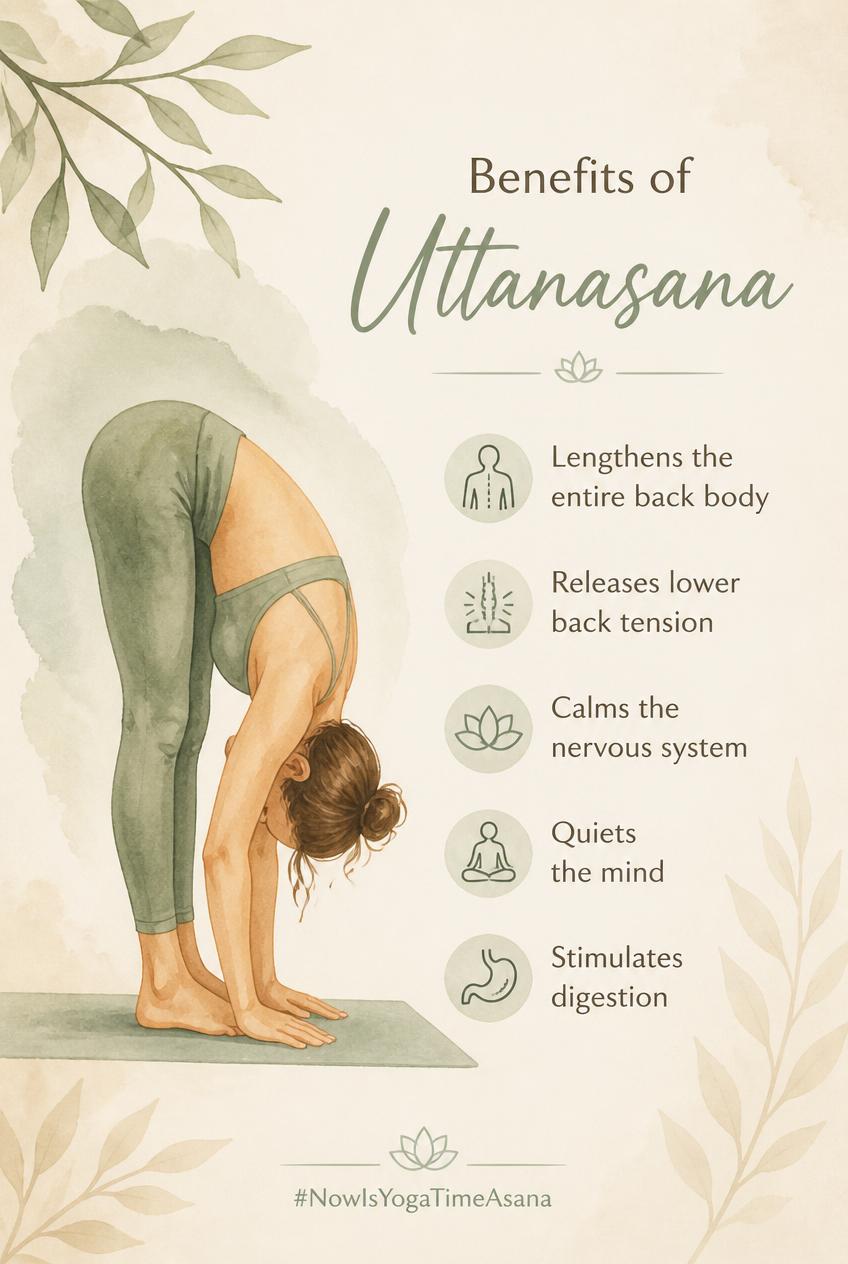
- Lengthens the entire back body — hamstrings, calves, spine, and posterior neck
- Decompresses the lumbar spine, releasing chronic lower back tension
- Calms the nervous system through mild inversion and breath regulation
- Slows the heart rate and reduces mental chatter
- Stimulates digestion through gentle compression of the abdominal organs
- Releases tension accumulated in the neck and shoulders
- Builds hamstring flexibility over time without strain
- Creates a moment of genuine inward quiet — grounding and centering. A moment which you can explore in How to Return to Yourself in 30 Seconds
Contraindications and Precautions
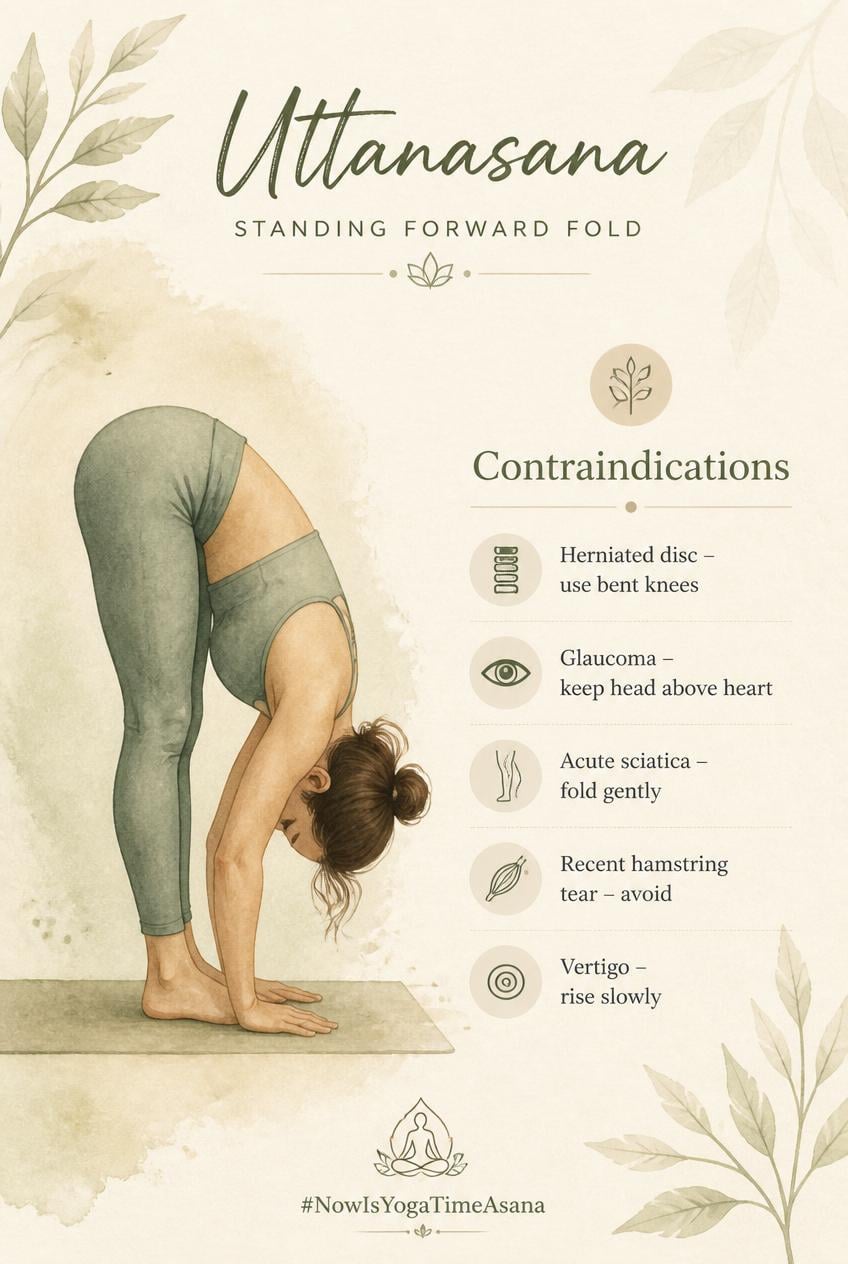
- Herniated disc or acute sciatica — fold with bent knees only, or practice a supported version with hands on a chair; avoid deep forward folding
- Glaucoma or high blood pressure — avoid full inversion; practice with hands on blocks or a chair, keeping the head above the heart
- Recent hamstring tear — approach with extreme care; keep knees bent and avoid any sensation of sharp pulling at the sit bones
- Vertigo or dizziness — rise very slowly and keep the head above the heart; hold the wall or a chair for support
- Osteoporosis — avoid deep spinal flexion; use a supported modification with a neutral spine
Integration Into Your Practice
a) When to practice:
- Early in a standing sequence — after Tadasana, as the body begins to warm
- Within Sun Salutations — as a natural transition point between standing and floor
- As a pause between more demanding standing poses — to reset and release
- At the end of practice — as a quiet, cooling forward fold before Savasana
- Anytime during the day — at a desk or in a quiet moment, a simple forward fold to release the back and return to breath
b) Pair With:
- Tadasana (Mountain Pose) — the natural foundation before the fold
- Ardha Uttanasana (Half Standing Forward Fold) — the inhale counterpart that lengthens the spine
- Adho Mukha Svanasana (Downward Facing Dog) — shares the back body opening; deepen the sequence
- Prasarita Padottanasana (Wide-Legged Forward Fold) — a natural progression for deeper hamstring and hip release
- Paschimottanasana (Seated Forward Fold) — the seated counterpart; continue the theme of surrender and release
- Balasana (Child's Pose) — another gesture of yielding; a complementary resting shape
Teaching Cues
a) As you enter the pose:
- Inhale — grow tall first. Let the spine find its full length before you fold
- Hinge from the hips — imagine your pelvis as a bowl tipping slowly forward
- Soften the knees. This is not about straight legs — it's about a long spine
b) In the pose:
- Let the head be the last thing to arrive. Release the neck completely
- Every exhale — not deeper, but softer. Let gravity do the work
- Feel the weight of your skull. Trust the ground to hold you
- Your hamstrings don't need to stretch — they need permission to release
c) Coming out of the pose:
- Hands to hips. Root through your feet. Rise like a wave — from the base of the spine, vertebra by vertebra
Yamas & Niyamas in Uttanasana
Ahimsa (non-harm):
- Notice where you're forcing. This pose is not a test of flexibility — it's an invitation to meet yourself without judgement
Santosha (contentment):
- Wherever you are today — hands at the shins, fingertips on blocks, or floor — this is exactly the right place. Stay here with ease
Svadhyaya (self-study):
- What does your body tell you today? Is the tightness in the legs, the lower back, or the breath? Simply notice — without needing to fix
Tapas (discipline through consistency):
- You showed up. You folded forward. That quiet commitment — day after day — is where transformation lives
Conclusion
Uttanasana is a practice in surrender. Not the surrender of giving up — but the deeper surrender of trusting the body to open when given space, time, and breath. In folding forward, we release the weight of holding ourselves upright, and in that release, something in the nervous system begins to quiet. The back body softens. The mind settles. The breath deepens on its own.
Return to this pose often. Not to reach the floor, but to practice letting go. Every fold is different. Every exhale opens a little more. Uttanasana reminds us that growth in yoga is rarely about effort — it is about learning, again and again, to release.
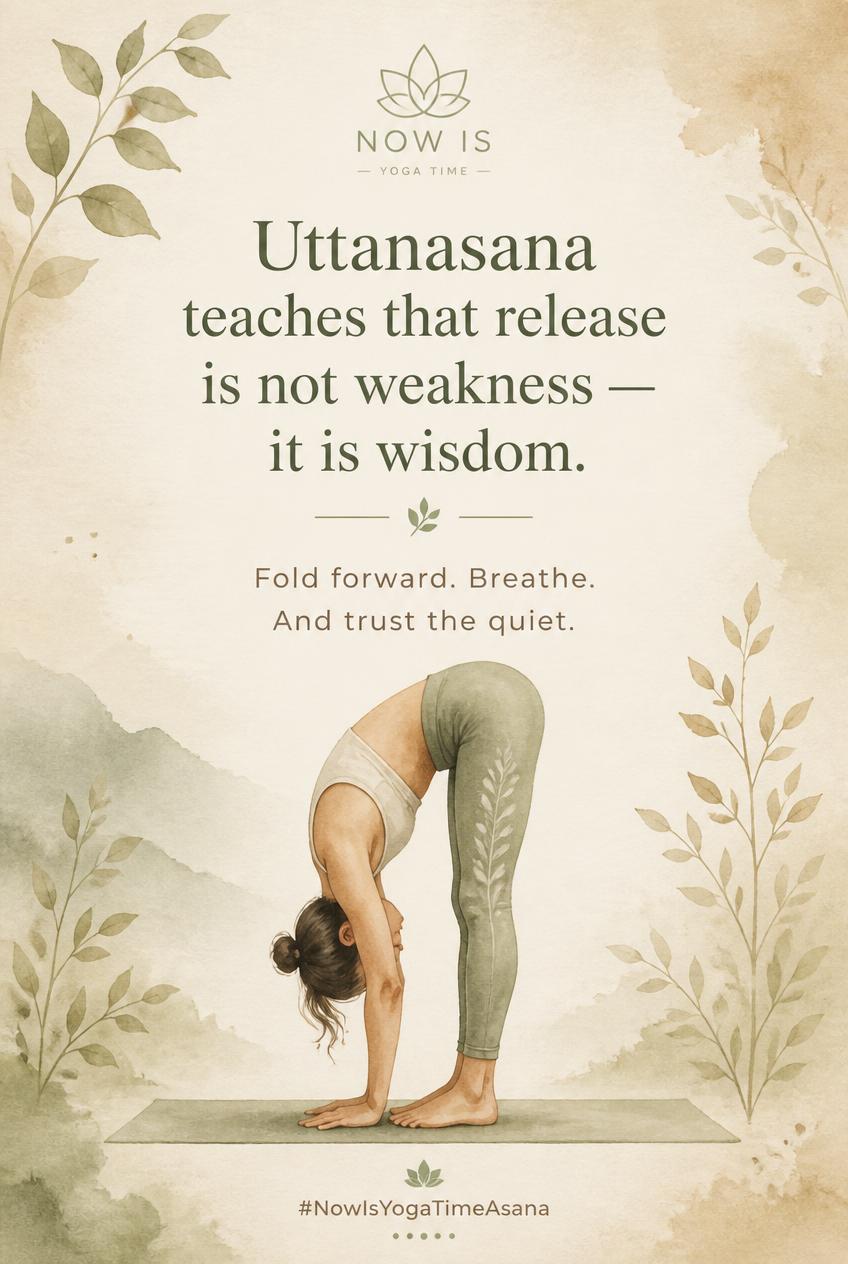
Fold forward. Breathe. And trust the quiet.
Previous Asana ← Uttanasana → Next Asana