Now is Yoga Time → 8 Limbs of Yoga → Yama → Satya

Satya — The Yoga of Honest Living
Truth is not always comfortable. But it is always free.

Introduction
There is a particular exhaustion that comes from living inauthentically.
Not the tiredness of a long day or a hard week. Something deeper. The slow, accumulating weight of performing a version of yourself that isn't quite real. Of saying yes when you mean no. Of staying silent when something in you needs to speak. Of pretending — to others, or to yourself — that everything is fine when it isn't.
Most of us know this feeling. Few of us name it for what it is.
It is the cost of living without Satya.
Satya — the second of Patanjali's five Yamas — means truth. Truthfulness. The alignment between what we think, what we say, and what we do.
It sounds simple. In practice, it is one of the most demanding, most liberating, and most quietly radical of all the yoga principles.
Because the truth, when we are willing to look at it honestly, has a way of setting things free.
This article is a quiet invitation to explore what Satya actually means — and how to bring it into your practice, your body, and your daily life. This article is also part of a greater theme of Yoga Philosophy.
What Is Satya?
Sanskrit: Satya (सत्य)
Translation: Truth, truthfulness, honesty, reality
Category: The second of the five Yamas — the outer ethical observances in Patanjali's eight-limbed path
The word Satya comes from the Sanskrit root sat, meaning that which is — reality, existence, being. Satya, then, is not just honesty as a social virtue. It is alignment with reality itself. With what is actually true — not what we wish were true, not what is convenient, not what protects us from discomfort.
In the Yoga Sutras, Patanjali offers a remarkable promise about the practitioner who has fully established Satya: "Satya pratishthayam kriya phala ashrayatvam" — for one established in truth, actions and their results come into perfect alignment. What you say becomes what is. Your words carry the weight of reality.
This is not magic. It is the natural consequence of a life lived in honest alignment. When there is no gap between the inner and the outer, between thought and word and deed — the energy of the whole person moves in one direction. Nothing is wasted in the maintenance of illusion.

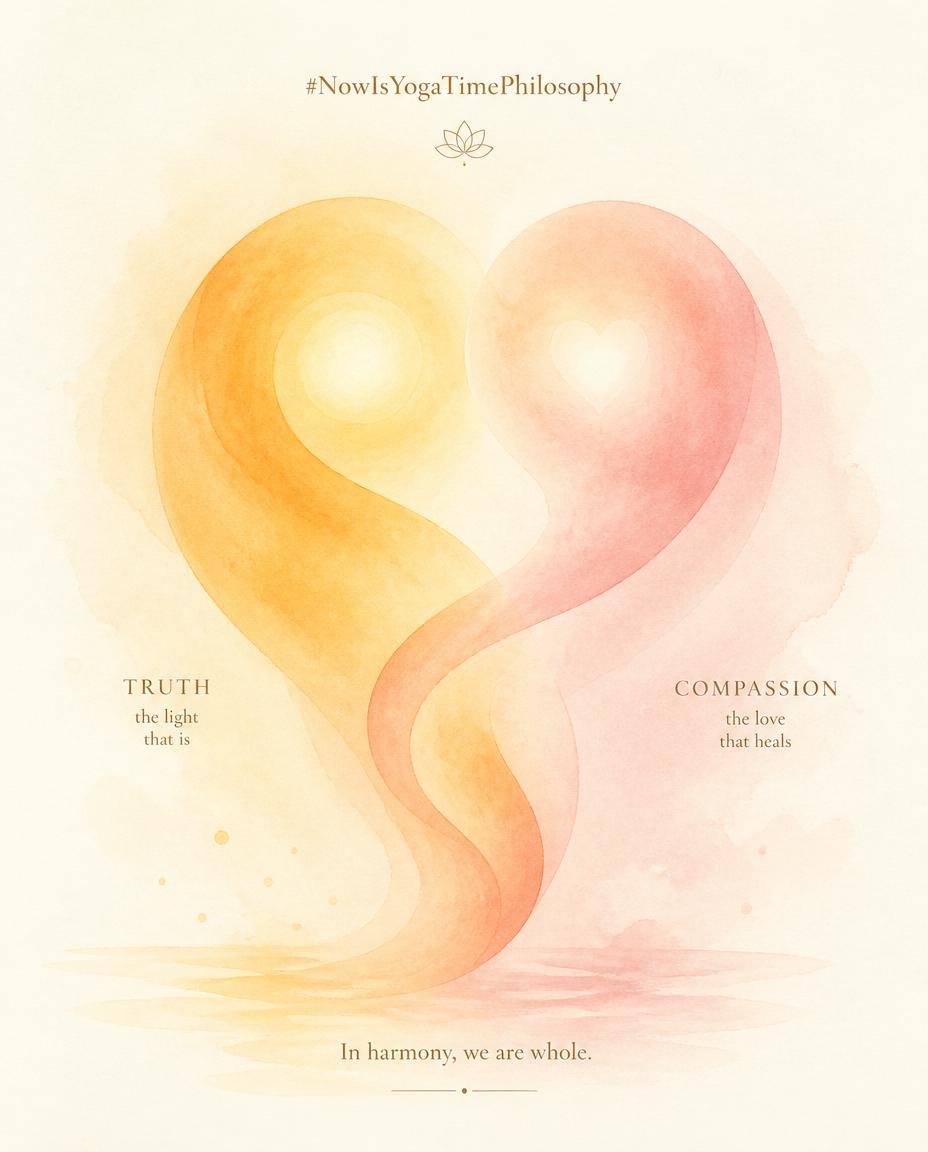
Satya and Ahimsa — Truth with Compassion
Before exploring Satya in its depth, there is something essential to understand.
In the yogic tradition, Ahimsa — nonviolence — always comes first. Always takes precedence. And this is not accidental.
Truth without compassion can wound. Words can be honest and still be weaponized. A person can speak the truth in a way that is designed to harm, to diminish, to control. This is not Satya. This is using truth as a blade.
The practice of Satya asks that truth be offered in the spirit of Ahimsa — with care, with timing, with kindness. Asking, before we speak: Is this true? Is this kind? Is this necessary?
When all three are present — when truth and compassion meet — something extraordinary becomes possible. Real communication. Real connection. The kind of honesty that opens people rather than closes them.
This is the marriage of Satya and Ahimsa. And it is the heart of conscious relationship.
The Many Layers of Satya
Satya is not only about avoiding lies. That is its most obvious dimension, but not its deepest.
Truthfulness in speech is the beginning. Not saying things we know to be false. Not exaggerating, not minimizing, not distorting. Letting our words reflect reality as closely as we can.
Truthfulness in action goes further. Our actions speak louder than our words. We can say one thing and do another — and this gap is its own form of dishonesty. Satya asks that what we do be consistent with what we say, and with what we believe.
Truthfulness with oneself is the most challenging layer of all.
It is easy to be honest with others when honesty is comfortable. It is far harder to be honest with ourselves when the truth is something we would rather not see. The dream we have been postponing. The relationship that no longer serves. The habit we have been tolerating. The version of ourselves we have been performing rather than living.
This is where Satya does its deepest work. Not in grand moments of confession, but in the quiet, daily practice of seeing clearly. Without dramatizing. Without punishing. Just — seeing.

Satya in Daily Life
In conversation: Notice the moments when you soften a truth to avoid discomfort. When you say "I'm fine" and you're not. When you agree to something you don't actually believe. These are not moments to judge yourself for — they are moments to notice. Awareness comes first.
In commitments: Every time you make a promise you don't intend to keep, or commit to something out of social pressure rather than genuine willingness — you create a small internal fracture. Satya asks that your yes be a real yes, and your no be a real no.
In self-talk: The inner voice matters. The stories we tell ourselves about who we are, what we are capable of, what we deserve — these are forms of speech too. Are they true? Or are they inherited scripts, old wounds dressed up as facts?
In the body: The body often knows the truth before the mind is willing to acknowledge it. The tightness in the chest when something is wrong. The ease that arrives when we make a decision that is right. Satya includes learning to listen to these signals — to trust the body's honest intelligence.
When Satya Is Difficult
There are moments when truth feels dangerous.
When speaking honestly might cost us something — a relationship, a job, someone's approval. When the truth we need to tell is about ourselves, and it requires admitting something we have long preferred not to see. When honesty feels like exposure, like vulnerability, like risk.
These are the moments when Satya asks the most of us.
And these are the moments when its practice is most transformative.
Because every time we choose honesty in a difficult moment — every time we say the true thing instead of the convenient thing — something in us becomes freer. More grounded. More real.
The fear of truth is almost always greater than the truth itself.
What we discover, again and again, is that honesty — offered with care, with courage, with kindness — almost always creates more connection, not less. More trust, not less. More freedom, not less.
The practice is worth it. Every time.

Satya and the Nervous System
Dishonesty is expensive — physiologically.
When we say things we don't believe, act in ways that contradict our values, or maintain a persona that doesn't reflect who we truly are — the body registers the cost. Studies in psychology and neuroscience consistently show that deception, including self-deception, activates stress responses. The cognitive load of maintaining a false narrative is real, measurable, and exhausting.
Honesty, by contrast, is relaxing. When we have nothing to hide — when the inside matches the outside — the nervous system settles. The breath deepens. The body unclenches.
This is not merely metaphor. It is biology.
Satya is not just an ethical principle. It is a physiological practice. A way of living that allows the body to rest in its own integrity — to stop spending energy on the maintenance of illusion and redirect that energy toward what actually matters.
Satya on the Mat
The yoga mat is a remarkable mirror.
Every time we pretend we can go deeper into a pose than we actually can, we practice dishonesty. Every time we compare ourselves to others and shape our practice around what it looks like rather than what it feels like, we practice dishonesty. Every time we push through pain to maintain an image — of strength, of flexibility, of progress — we practice dishonesty.
Satya on the mat looks like this: acknowledging where you actually are. Not where you think you should be. Not where you were last week. Not where the person beside you is. Where you actually, honestly are — in this body, on this day, with this breath.
This kind of honesty is not weakness. It is the foundation of a practice that actually transforms.
Because transformation only begins where we are willing to tell the truth about our starting point.
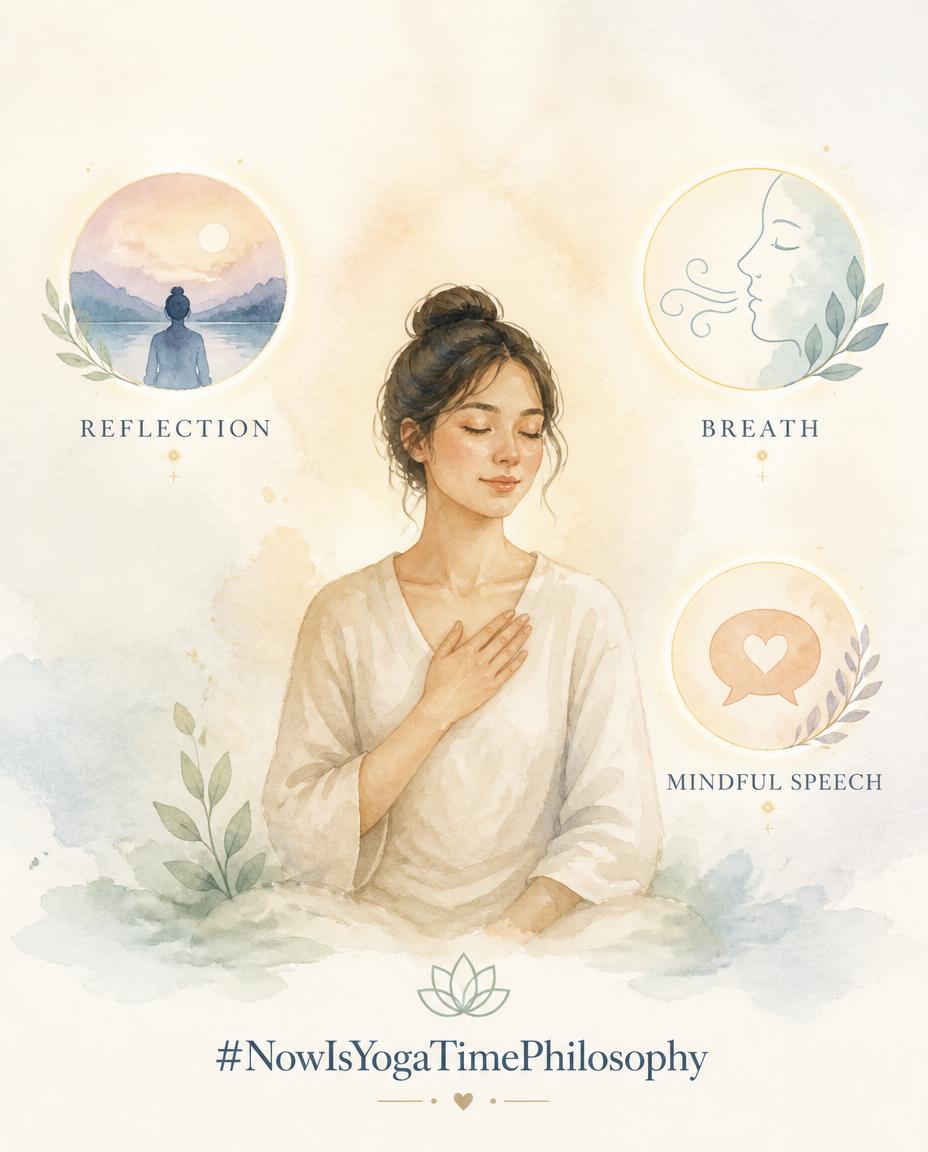
Practices for Cultivating Satya
Daily reflection: At the end of each day, take five minutes in stillness. Ask yourself — where was I honest today? Where was I not? Not to judge yourself. Simply to see.
The pause before speaking: Before responding in a difficult conversation, create a small pause. Long enough to ask: Is what I am about to say true? Is it kind? Is it necessary? This pause, practiced regularly, changes the quality of everything you say.
Honest journaling: Write without an audience. Without performing. Let the words be true — even when, especially when, they are uncomfortable. The page holds what we are not yet ready to say out loud.
Body listening: Once a day, check in with the body honestly. How am I actually feeling — not how do I think I should be feeling, or how do I want others to think I am feeling? The body always knows. The practice is learning to ask.
Releasing social performance: Choose one interaction today where you say what you actually think, feel, or need — instead of what is expected. Start small. Let honesty be practiced in safe spaces before it is required in difficult ones.
Benefits of Practicing Satya
- Deeper, more genuine relationships built on real trust
- Deeper, more genuine relationships built on real trust
- Reduced cognitive and emotional fatigue from maintaining false appearances
- Greater self-knowledge — you begin to know who you actually are
- Clearer decision-making, because decisions are based on reality rather than wishful thinking
- A quieter, calmer nervous system as the effort of performance falls away
- Increased self-respect — the natural consequence of living with integrity
- A practice life that is genuinely transformative, because it begins from an honest starting point
Satya and the Other Yamas
Ahimsa (nonviolence): As explored above — always the guiding principle. Truth in the spirit of kindness. Honesty as care, not weaponization.
Asteya (non-stealing): Taking credit for what isn't ours, exaggerating our contributions, presenting borrowed ideas as original — these are forms of dishonesty that Satya asks us to examine.
Aparigraha (non-grasping): Clinging to a false self-image — a past identity, an idealized version of ourselves — is a subtle form of untruth. Satya and Aparigraha together invite us to hold our self-concept lightly, to let it evolve as we evolve.
A Moment of Satya — Mini Practice
Sit quietly. Close your eyes.
Take a slow breath in.
And as you exhale — let something soften.
Ask yourself, without pressure, without judgment:
What is true for me right now — that I have not yet allowed myself to fully acknowledge?
It might be something small. Something large.
Something about your practice, your relationships, your work, your body, your path.
Let whatever arises be welcome.
You don't need to act on it today.
You only need to see it.
Breathe again.
Inhale — I am willing to see clearly.
Exhale — I release the need to pretend.
Stay here for as long as you need.
This is Satya. The practice of coming home to what is real.
Conclusion
Satya is a practice of courage.
Not the dramatic courage of grand gestures — but the quiet, daily courage of choosing truth in the small moments. Of seeing clearly. Of speaking honestly. Of living in alignment with what you actually believe, value, and feel.
It is demanding. There will be moments when the honest thing is the harder thing. When it would be easier to perform, to deflect, to tell a more comfortable story.
In those moments, Satya asks you to pause. To breathe. And to choose truth — gently, carefully, with as much kindness as you can bring.
Over time, this practice changes everything. The way you speak. The way you listen. The way you know yourself. The quality of your relationships. The depth of your practice.
Because a life lived honestly — even imperfectly, even haltingly — is a life that is genuinely your own.
And that, in the end, is what all of yoga is pointing toward.
Not someone else's truth. Yours.