Now is Yoga Time → 8 Limbs of Yoga → Niyama
Niyama — The Inner Observances of Yoga
The Yamas taught us how to meet the world.
The Niyamas teach us how to meet ourselves.
Introduction
There is a particular kind of work that nobody sees.
Not the work we perform for others — the visible effort, the public output, the results that can be measured and praised. Something quieter. The work of tending to the inner life. The daily, unglamorous, essential practice of maintaining the quality of our own inner ground.
This is the work of Niyama.
The second of Patanjali's eight limbs, the Niyamas are five personal observances — disciplines of the self, practices of inner cultivation. Where the Yamas govern how we meet the world around us, the Niyamas ask a different and perhaps more demanding question:
How do I meet myself?
How do I tend to my own body, my own mind, my own inner life? With what quality of attention? With what degree of honesty? With what relationship to the sacred — however I understand that word?
These are not abstract philosophical questions. They are practical, daily invitations. And they form the inner foundation upon which all deeper yoga practice rests.
What Is Niyama?
Sanskrit: Niyama (नियम) Translation: Observance, rule, inner discipline, personal practice Category: The second of the eight limbs in Patanjali's Yoga Sutras — the inner ethical observances
The word Niyama comes from the Sanskrit prefix ni (inward, within, down) and yama (to rein, to govern). Where Yama governs our relationship with the outer world, Niyama governs the inner world — the private landscape of habit, attention, devotion, and self-knowledge.
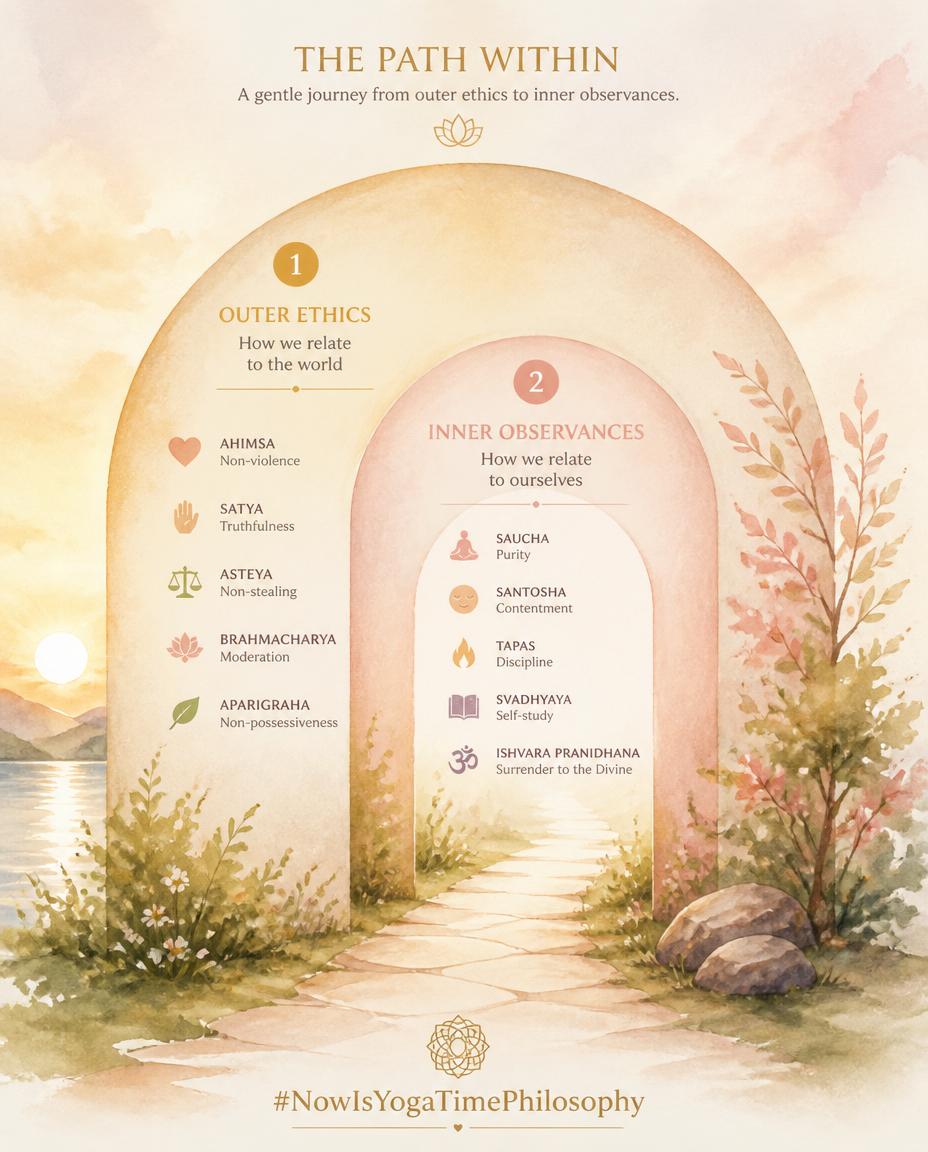
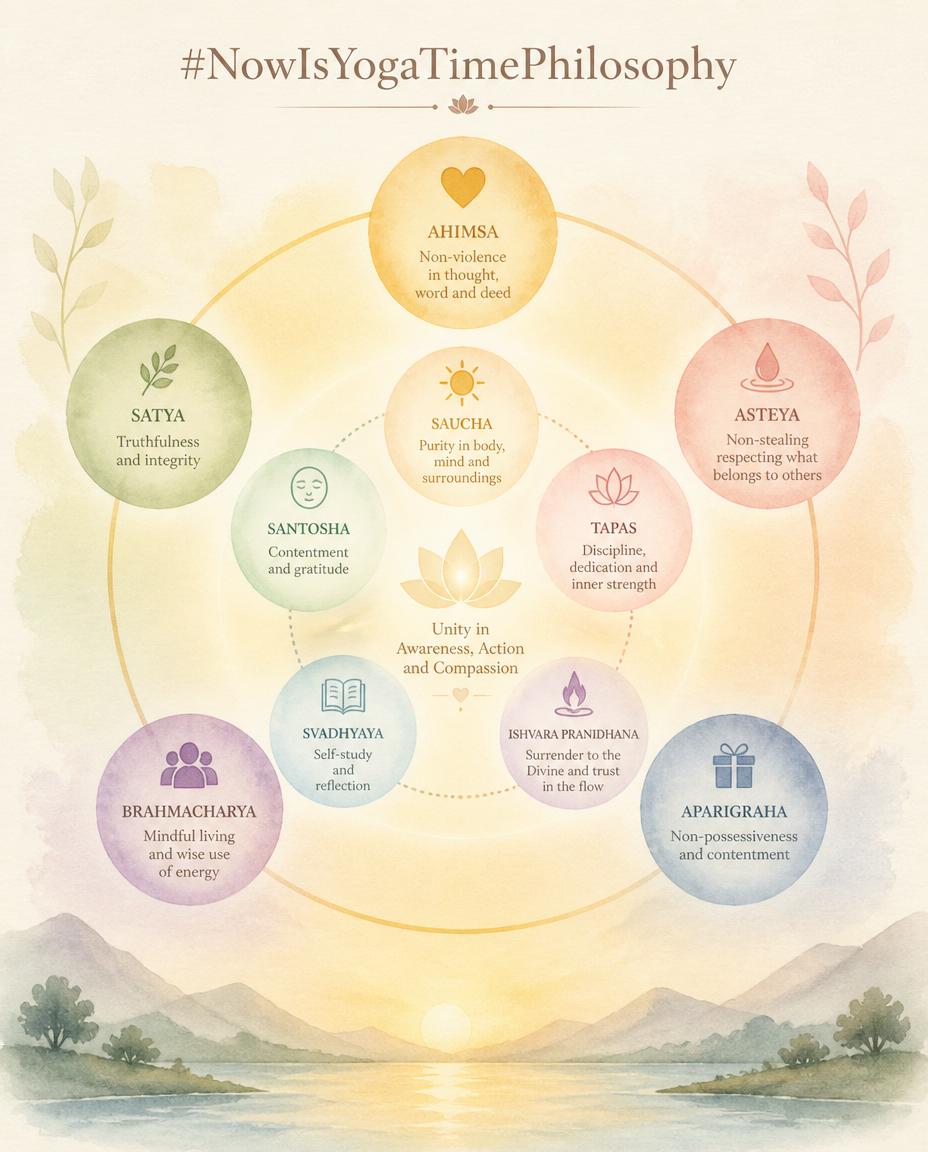
There are five Niyamas:
- Saucha — purity, cleanliness
- Santosha — contentment
- Tapas — discipline, inner fire
- Svadhyaya — self-study, self-inquiry
- Ishvara Pranidhana — surrender to the divine
Together, they form a complete map for inner cultivation — from the care of the physical body all the way to the surrender of the personal will into something larger than the self.
Why Niyama Comes After Yama
The order of Patanjali's eight limbs is not arbitrary.
The Yamas come first because they address the most obvious and immediate source of disturbance — the friction created when we move through the world in ways that cause harm, dishonesty, and taking. Before we can go inward with any depth, the outer life must be brought into some degree of alignment.
But the Yamas alone are not enough.
A person can be outwardly ethical — honest, kind, non-grasping — and still be in profound inner disorder. Untended habits. An unexamined mind. A body neglected or abused. A complete absence of genuine self-knowledge. An inner life so noisy and chaotic that stillness is simply not available.
The Niyamas address this inner dimension. They ask us to take responsibility not just for how we affect the world, but for the quality of the inner ground from which all our actions arise.
Because what we bring to the world is always, ultimately, a reflection of what lives inside us.
The Five Niyamas — An Overview

1. Saucha — Purity
Saucha means cleanliness — of body, of environment, and of mind.
At the physical level, it is the care we bring to the body: how we nourish it, how we rest it, how we move it, how we tend to the spaces we inhabit. Clean food. Clean water. A living space that supports rather than overwhelms.
But Saucha extends inward. The quality of what we consume — not just food, but information, images, conversations, relationships. The mental environment we create through our habits of attention. Whether the inner space is clear enough to allow genuine perception.
Patanjali observes that consistent practice of Saucha naturally creates a desire for greater purity — a movement away from excessive sensory indulgence, not out of asceticism, but out of the genuine experience of how clarity feels compared to noise.
A clean vessel receives more. A clear mind sees more. This is the wisdom of Saucha.
→ Read the full article: Saucha — The Practice of Inner and Outer Purity
2. Santosha — Contentment
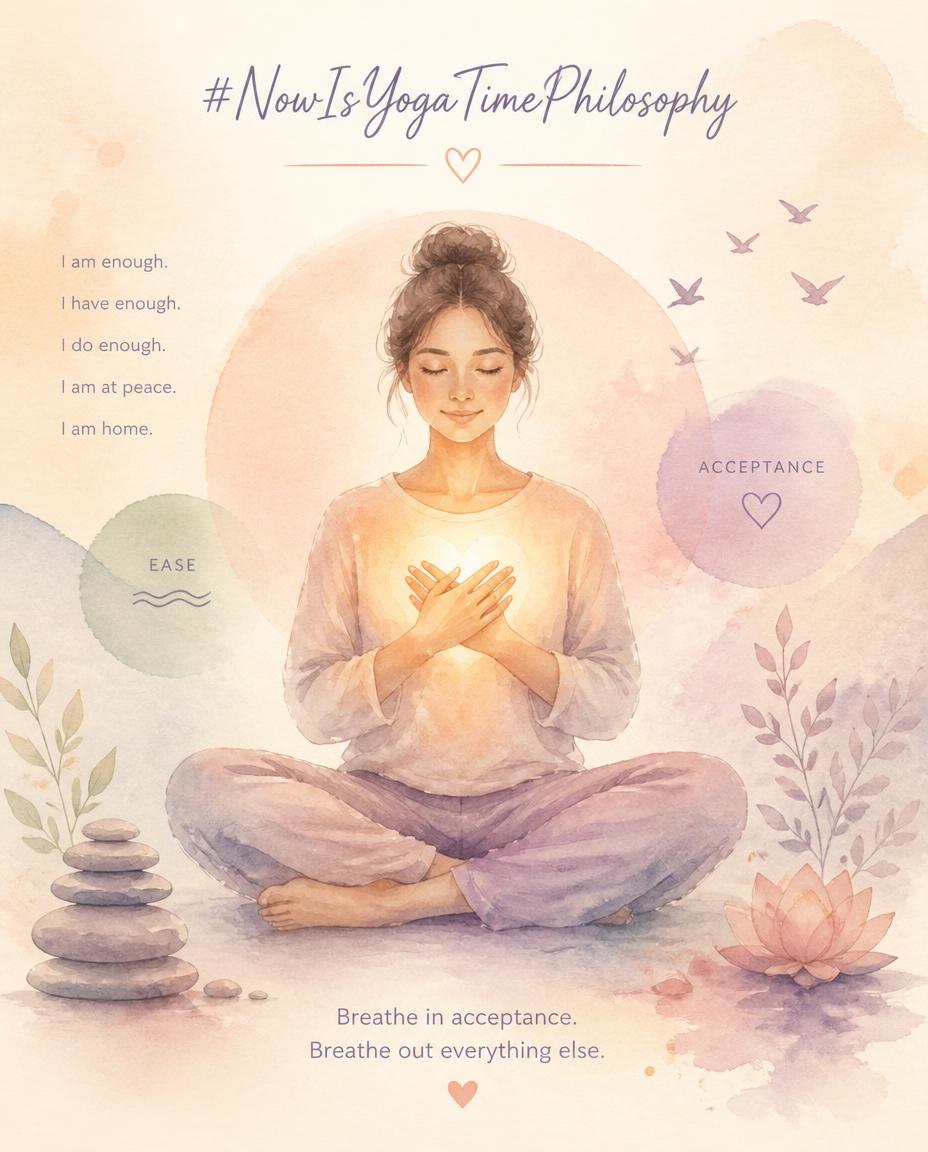
Santosha is one of the most radical and countercultural principles in the entire yoga tradition.
In a world that profits from our perpetual dissatisfaction — that tells us, constantly, that what we have is not enough, that who we are is not enough, that the next purchase or achievement or experience will finally complete us — Santosha says something quietly revolutionary:
What is here, right now, is enough. You are enough.
This is not passivity. It is not the abandonment of aspiration or growth. It is the practice of finding a ground of genuine okayness beneath all the striving — a place from which we can pursue our lives without the frantic edge of dissatisfaction driving every step.
Patanjali tells us that Santosha brings anuttama sukha — unsurpassed happiness. Not the pleasure of getting what we want, but the deep ease of no longer being at war with what is.
→ Read the full article: Santosha — The Radical Practice of Contentment
3. Tapas — Inner Fire
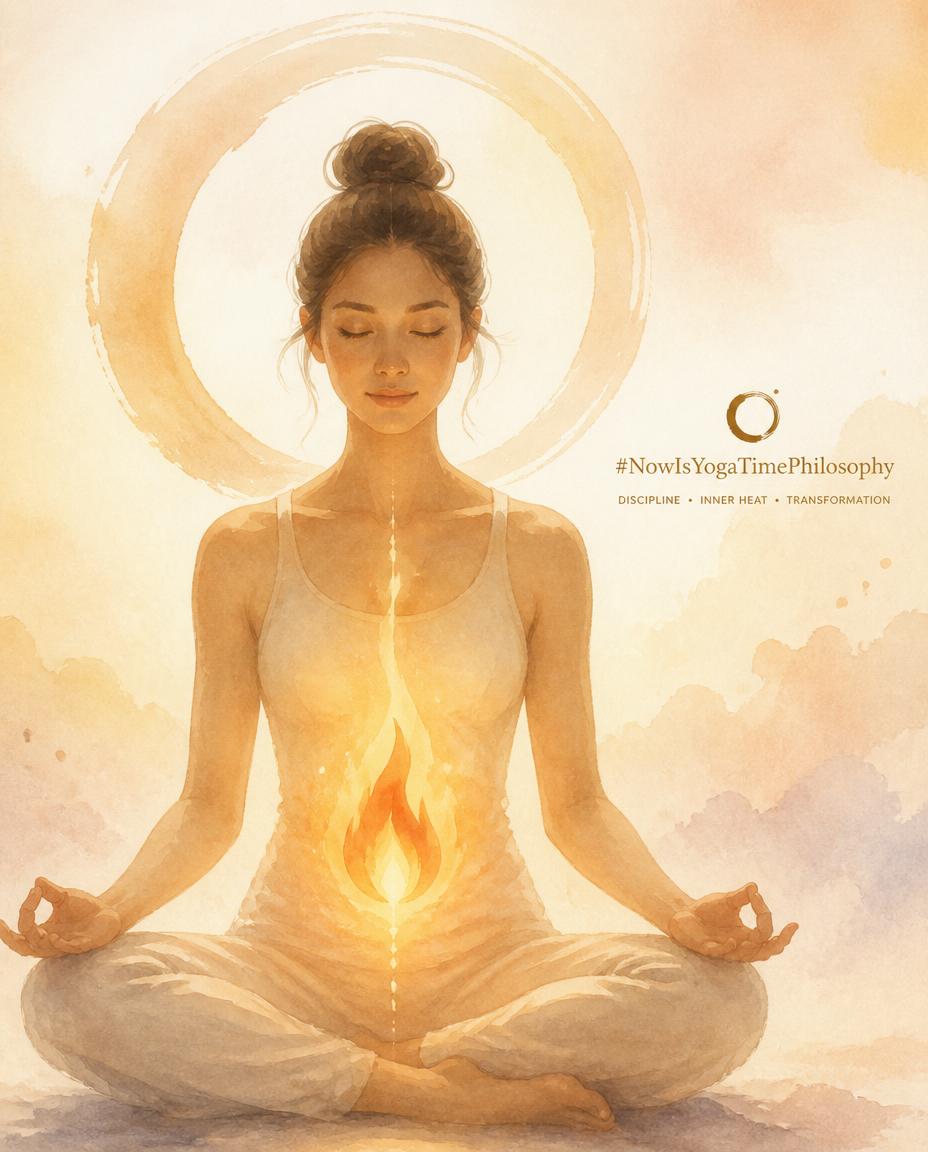
Tapas is often translated as austerity — and this translation, like Brahmacharya, has frightened many people unnecessarily.
Tapas is not self-punishment. It is not deprivation. It is not the performance of suffering in hope of spiritual reward.
Tapas is the inner fire of discipline. The willingness to do the thing that needs doing — even when it is uncomfortable, even when the easier path is available, even when nobody is watching.
It is the commitment to show up — for the practice, for the work, for the growth — with consistency and integrity. Not perfectly. Not without difficulty. But steadily, patiently, with the quiet determination of someone who understands that transformation is not an event but a direction.
The word tapas also means heat — specifically, the heat generated by friction, by the rubbing of discipline against resistance. This heat is not punishment. It is purification. It burns away what is unnecessary and leaves what is essential.
→ Read the full article: Tapas — The Yoga of Discipline and Inner Fire
4. Svadhyaya — Self-Study
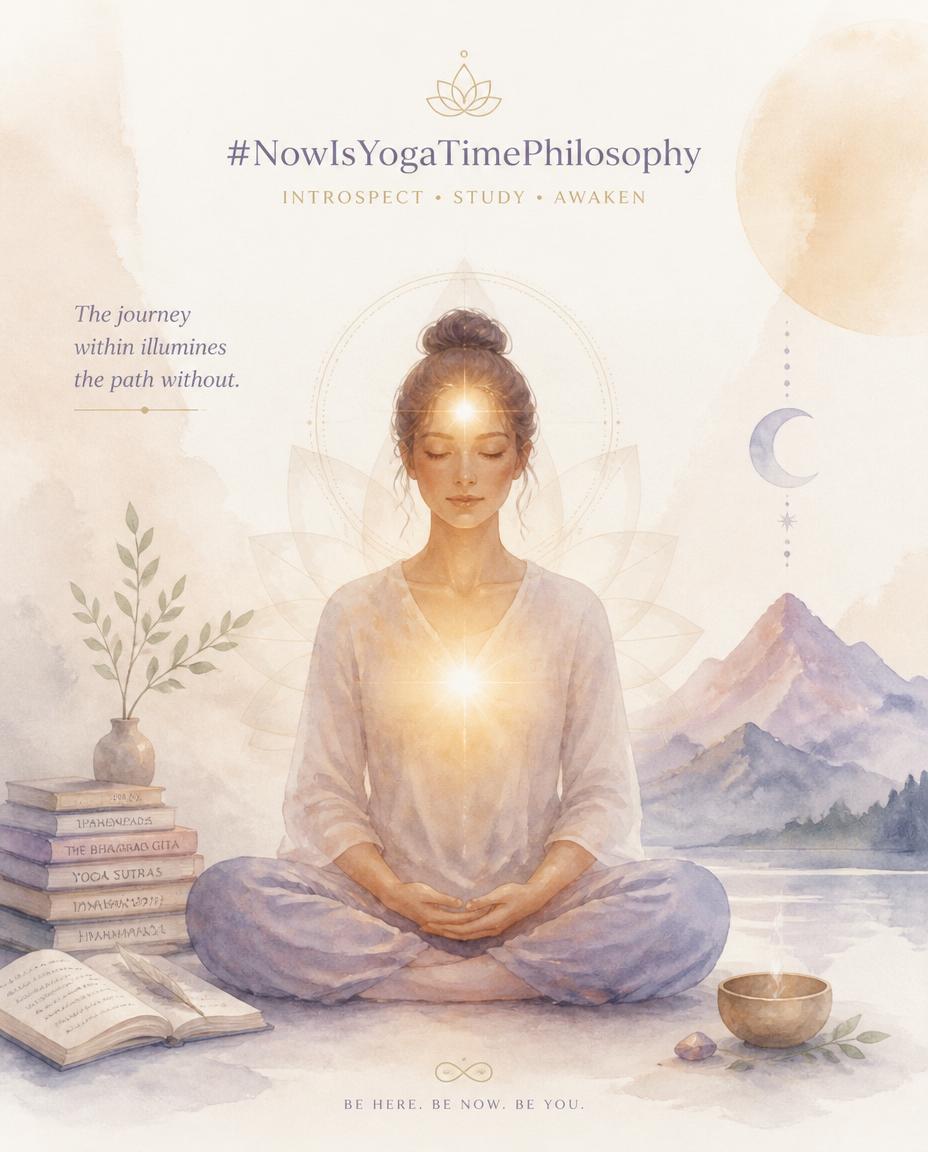
Sva means self. Adhyaya means study, inquiry, examination. Svadhyaya is the practice of turning genuine attention toward the self — of asking, with honesty and without flinching: who am I, really?
This inquiry takes many forms in the yoga tradition. The study of sacred texts — not as passive reading, but as active contemplation, allowing the teachings to illuminate our own experience. Reflection — the practice of examining our own patterns, reactions, habitual responses, and asking where they come from and whether they still serve. Meditation — the direct inquiry into the nature of the mind itself, prior to its contents.
But Svadhyaya is not only formal. It is present in every moment of genuine self-honesty. Every time we catch ourselves in a familiar reaction and ask why — that is Svadhyaya. Every time we sit with a difficult emotion rather than immediately escaping it — that is Svadhyaya. Every time we are willing to discover that we were wrong, that we have grown, that the old story no longer fits — that is Svadhyaya.
→ Read the full article: Svadhyaya — The Practice of Self-Study
5. Ishvara Pranidhana — Surrender
The fifth Niyama is the one that asks the most — and offers the most in return.
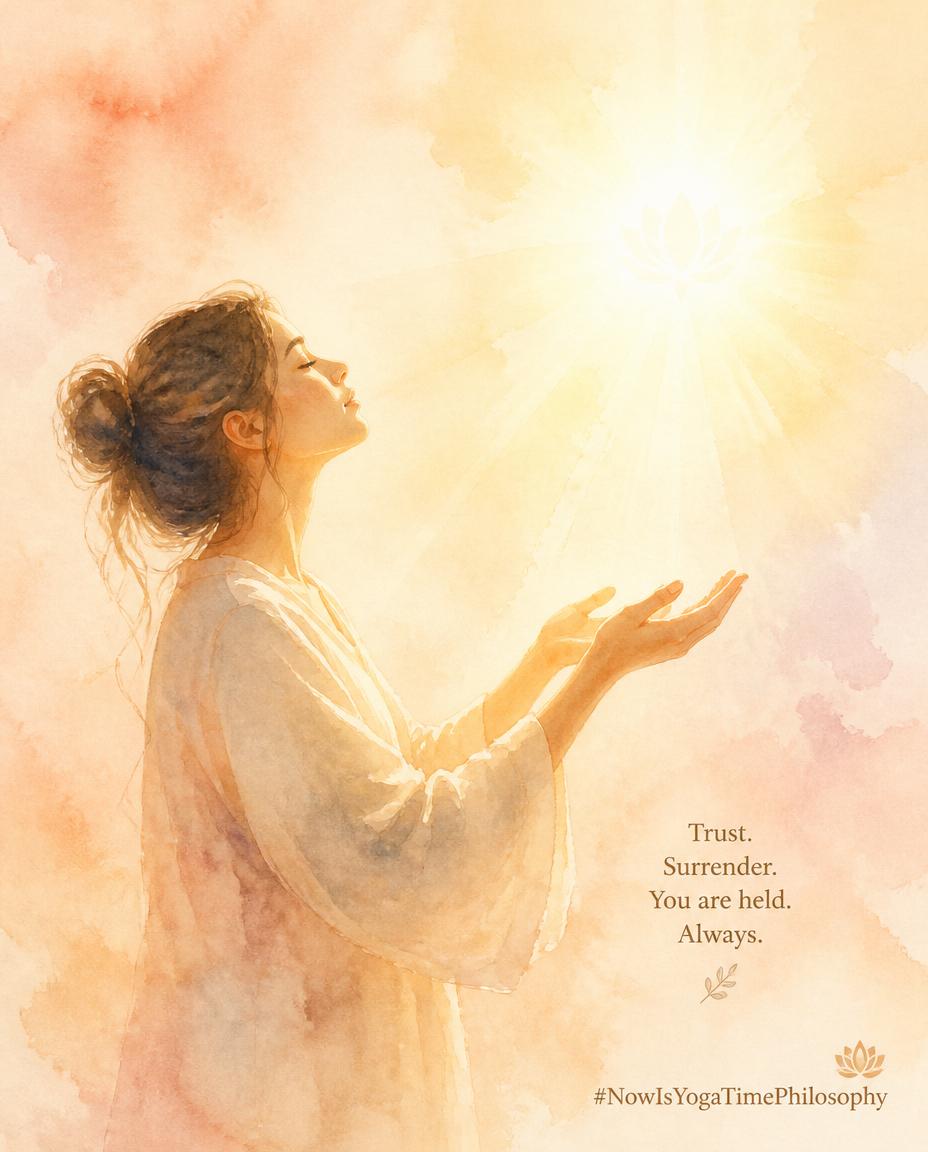
Ishvara Pranidhana means surrender to the divine. Dedication of all actions and their fruits to something larger than the personal self. The release of the ego's grip on the steering wheel of life.
Ishvara means the divine, the lord, the universal consciousness — however one understands these words. The tradition is deliberately open here. Ishvara is not a dogmatic deity but a pointing — toward whatever is larger, wiser, and more complete than the individual ego. For some practitioners this is God. For others it is nature, or life itself, or the deepest truth of their own being.
Pranidhana means to bow before, to dedicate, to surrender with full awareness and full intention.
Together: the practice of living not for the ego's agenda, but in alignment with something deeper. Of doing one's best and then releasing the outcome. Of trusting that life, guided by sincere practice and honest intention, will unfold as it needs to — even when that unfolding looks nothing like what we planned.
This is the Niyama that completes the path. It is also the one that requires everything else to be in place first — the ethical foundation, the inner discipline, the self-knowledge — before genuine surrender becomes possible.
→ Read the full article: Ishvara Pranidhana — The Practice of Surrender
The Niyamas as a Daily Practice
The Niyamas are not weekend retreats or occasional aspirations.
They are daily. Continuous. Woven into the fabric of ordinary life.

Saucha in the way you begin the morning — with cleanliness and intention rather than chaos and reactivity. Santosha in the moment you notice dissatisfaction arising and choose, deliberately, to find what is already enough. Tapas in the decision to practice when you don't feel like it — when the mat is rolled up and the excuses are plentiful and you show up anyway. Svadhyaya in the pause before reacting — the moment of genuine self-inquiry that asks why am I responding this way? Ishvara Pranidhana in the exhale at the end of the day — the release of what you cannot control, the trust that something larger is holding what you cannot.
This is the Niyama practice. Not grand. Not dramatic. Just the quiet, steady, daily tending of the inner life.
Over time — through seasons, through years — this tending changes everything.
Niyama and the Nervous System
The Niyamas, practiced consistently, have a profound effect on the nervous system.
Saucha reduces the cognitive and sensory load that keeps the system in a state of low-grade overwhelm. Santosha shifts the baseline from chronic dissatisfaction — a subtle but constant stress — toward genuine ease. Tapas builds the capacity to tolerate discomfort without being destabilized by it, which is the foundation of genuine resilience. Svadhyaya creates self-knowledge that reduces reactivity — we are less easily triggered when we understand our own patterns. Ishvara Pranidhana loosens the grip of the ego's constant effort to control outcomes — one of the most exhausting and futile activities the human mind engages in.
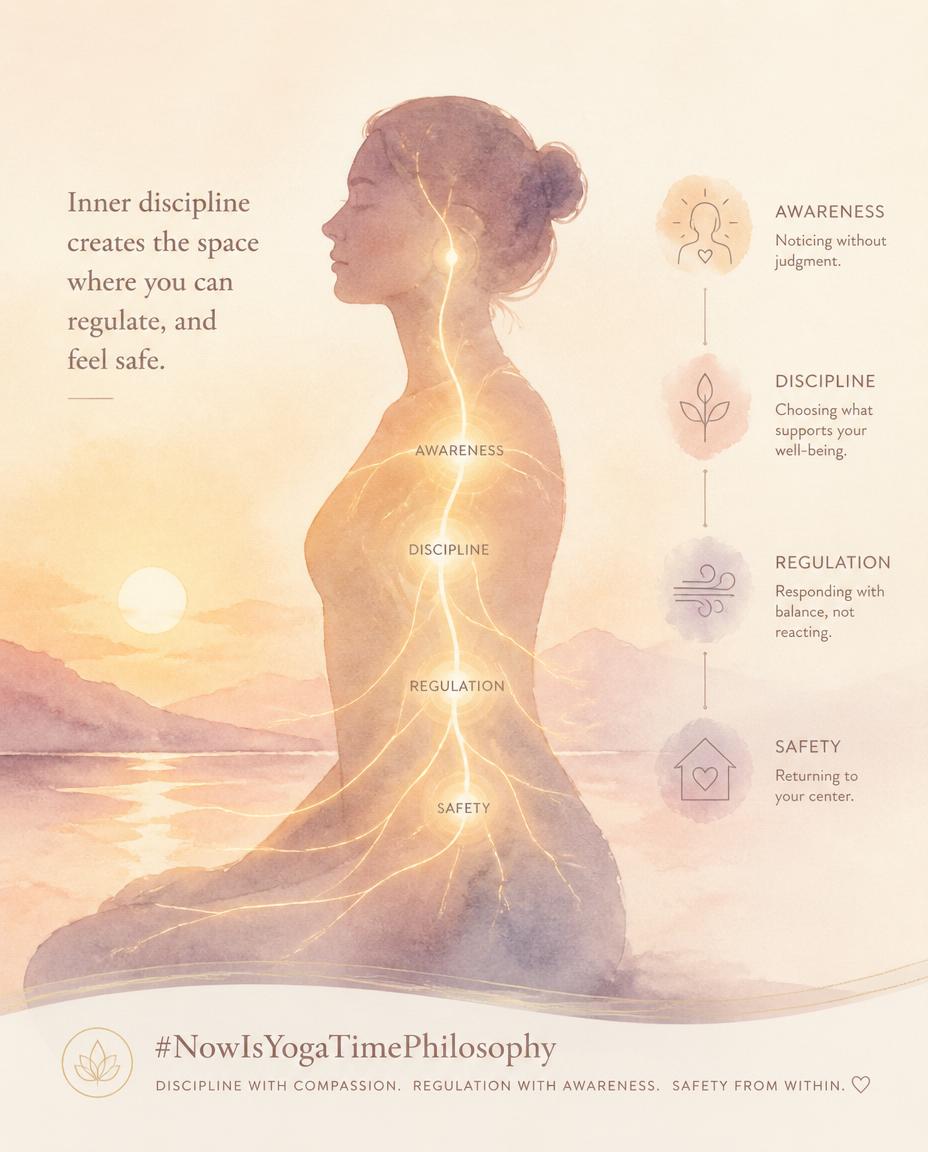
Together, the Niyamas create an inner environment in which the nervous system can genuinely settle. Not through suppression or avoidance, but through genuine cultivation.
A life lived with the Niyamas is a life that is, incrementally and sustainably, becoming calmer from the inside out.
Niyama and Yama — The Complete Ethical Foundation
The Yamas and Niyamas together form the first two limbs of the eight-limbed path — and they are often spoken of as a pair.
The Yamas are the outer foundation: how we meet the world. The Niyamas are the inner foundation: how we meet ourselves.
Without the Yamas, the Niyamas can become self-indulgent — a spiritual practice that is really just an elaborate form of navel-gazing, disconnected from the ethical reality of how we affect those around us.
Without the Niyamas, the Yamas can become performative — an outer ethical presentation that has no genuine inner life behind it.
Together, they create a human being who is both genuinely ethical in the world and genuinely cultivated within — whose outer life and inner life are aligned, and who moves through the world with both integrity and depth.
This is the foundation upon which all other yoga practice rests. And it is a foundation worth building carefully — one day, one practice, one choice at a time.
A Moment with the Niyamas — Mini Practice
Sit comfortably. Close your eyes.
Take one full breath — in through the nose, slowly out through the mouth. Let something soften.
Bring each Niyama to mind, one by one.
Not as concepts — as living questions.
Saucha — what needs to be cleansed or clarified in my inner life right now? (Breathe.)
Santosha — what is already here that is enough? (Breathe.)
Tapas — where is my practice asking more of me than I have been willing to give? (Breathe.)
Svadhyaya — what am I learning about myself right now, in this season of life? (Breathe.)
Ishvara Pranidhana — what am I holding onto that I am ready to surrender? (Breathe.)
You don't need to answer these questions fully today.
Simply let them live in you.
Let them do their work.
This is Niyama. The quiet, daily practice of tending the inner fire.
Niyama → Asana