Now is Yoga Time → 8 Limbs of Yoga → Yama
Yama — The Ethical Roots of Yoga
Before the breath. Before the posture. Before anything else — there is Yama.
Introduction
Most people come to yoga through the body.
A pose. A stretch. A moment of stillness after a long day. And this is a beautiful beginning — the body is always a faithful doorway.
But yoga, in its full depth, is something far greater than what happens on the mat.
At the heart of the classical yoga tradition lies a question that every sincere practitioner eventually encounters: How do I live?
Not how do I perform. Not how do I look. But how do I actually move through the world — in my relationships, in my choices, in the quiet moments when nobody is watching?
Yama is the yoga tradition's answer to that question.
The first of Patanjali's eight limbs, Yama is the ethical foundation upon which all other practice rests. Five principles. Five invitations. A complete map for conscious, compassionate living.
This is where yoga truly begins.
What Is Yama?
Sanskrit: Yama (यम)
Translation: Restraint, discipline, moral code
Category: The first of the eight limbs (Ashtanga) in Patanjali's Yoga Sutras
The word Yama comes from the Sanskrit root yam, meaning to rein in, to govern, to hold. In the context of yoga philosophy, it refers to how we govern our relationship with the world around us — with other people, with living beings, and with life itself.
Patanjali introduces the Yamas in the Yoga Sutras as mahavratam — the great vow. Universal. Not bound by time, place, class, or circumstance. These are not cultural guidelines or situational ethics. They are principles for every human being, in every moment.
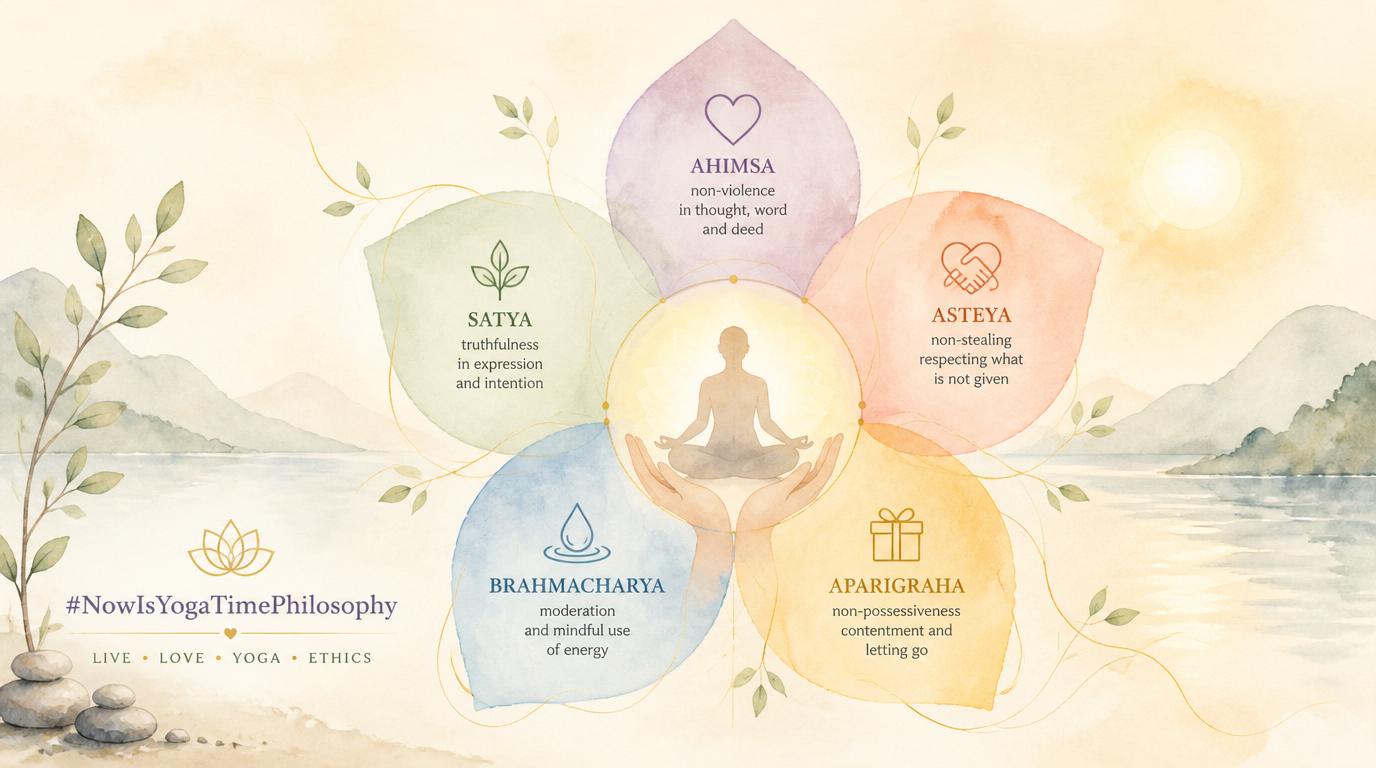
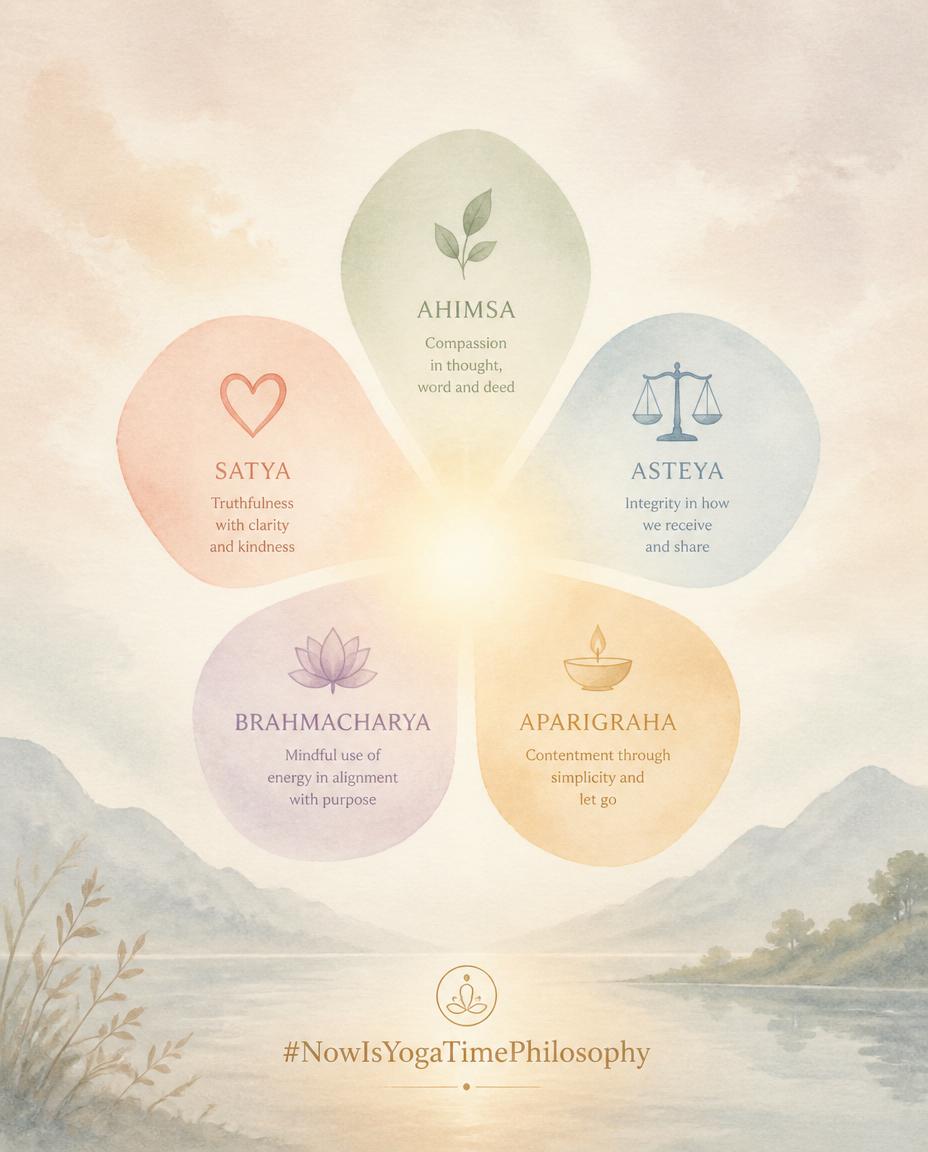
There are five Yamas in total:
- Ahimsa — nonviolence
- Satya — truthfulness
- Asteya — non-stealing
- Brahmacharya — right use of energy
- Aparigraha — non-grasping
Together, they form the outer ethical layer of the practice — the way we meet the world before we ever step onto the mat.
Why Yama Comes First
In Patanjali's eight-limbed path, the order is intentional.
Yama comes before Niyama (inner observances). Before Asana (posture). Before Pranayama (breath). Before meditation. Before everything.
This is not an accident.
The ancient yogis understood something that modern culture often forgets: inner transformation cannot be built on an unstable outer foundation. If our relationships are filled with harm, dishonesty, and grasping — no amount of physical practice will bring true peace. The noise of unethical living drowns out the quieter voice of awareness.
Yama clears the ground. It removes the static. It creates the conditions in which deeper practice can take root.
You cannot meditate your way out of a life built on harm. You cannot breathe your way out of habitual dishonesty. You cannot find stillness while grasping for more.
Yama is the invitation to attend to the outer life first — so that the inner life has somewhere quiet to grow.
The Five Yamas — An Overview

1. Ahimsa — Nonviolence
The first and most fundamental Yama. Ahimsa means causing no harm — in thought, in word, in action. Toward others, toward all living beings, and with equal seriousness, toward yourself.
It is not passivity. It is the active, daily practice of choosing gentleness over force, compassion over judgment, care over carelessness.
Ahimsa is the soil in which all other Yamas grow. Without it, the others lose their ground.
→ Read the full article: Ahimsa — The Practice of Nonviolence That Begins Within

2. Satya — Truthfulness
Satya means truth. Not just the absence of lies, but the commitment to aligning what we think, what we say, and what we do.
It is the practice of honesty — with others and, perhaps more challengingly, with ourselves. The willingness to see clearly. To speak with integrity. To stop performing a version of ourselves that isn't real.
Satya and Ahimsa are inseparable companions. Truth without compassion can wound. Compassion without truth can become avoidance. Together, they create the possibility of real, honest connection.
→ Read the full article: Satya — The Yoga of Honest Living
3. Asteya — Non-Stealing
Asteya extends far beyond the obvious. Yes, it means not taking what isn't ours. But in its subtler dimensions, it includes not stealing time, energy, attention, or credit. Not consuming more than we need. Not taking from the future to feed the present.
It is the practice of sufficiency — the quiet recognition that what we already have is enough. That we are enough.
Asteya asks us to examine our relationship with wanting. And to notice how much energy is spent in the pursuit of more, at the expense of presence with what is already here.
→ Read the full article: Asteya — The Freedom of Non-Stealing

4.Brahmacharya — Right Use of Energy
Often translated as celibacy, Brahmacharya is more accurately understood as the conscious, wise use of our vital energy.
We carry within us a finite reserve of life force — physical, emotional, creative, spiritual. How we spend it determines the quality of our experience and the depth of our practice.
Brahmacharya asks: where is my energy going? Is it nourishing what matters — or leaking away through distraction, excess, compulsion, and unconscious habit?
It is not about denial. It is about direction. About choosing, with awareness, how we invest the energy of this one life.
→ Read the full article: Brahmacharya — The Wisdom of Energy

5. Aparigraha — Non-Grasping
The last of the Yamas is perhaps the most quietly radical.
Aparigraha means non-possessiveness. Non-grasping. Not clinging — to things, to outcomes, to identities, to people, to a past version of yourself, or to an idea of how life should look.
It is the practice of holding things lightly. Of receiving what comes, offering what is needed, and releasing what is no longer serving.
In a culture that measures worth by accumulation — more things, more achievements, more followers, more experiences — Aparigraha is a profound act of resistance. And of freedom.
→ Read the full article: Aparigraha — The Art of Letting Go
Yama in Daily Life
The Yamas are not practiced on the mat.
They are practiced in the conversation where you choose honesty over convenience. In the moment you notice the impulse to take more than you need — and pause. In the way you speak to yourself at the end of a difficult day. In the quality of your attention when someone you love is speaking.

Every ordinary moment is an opportunity to practice.
This is what makes Yama the most demanding — and the most rewarding — dimension of yoga. It is never finished. There is always another layer, another relationship, another situation that invites you to return to these principles with fresh eyes.
Yama is a lifelong practice. Not a destination, but a direction.
Yama and the Nervous System
There is something the ancient yogis understood intuitively that modern science is now confirming.
Living in alignment with the Yamas calms the nervous system.
When we act in ways that conflict with our values — when we harm, deceive, grasp, or spend our energy carelessly — the body registers the dissonance. A low-grade stress response. A subtle bracing. An undercurrent of unease that no amount of meditation can fully resolve if the source remains unaddressed.
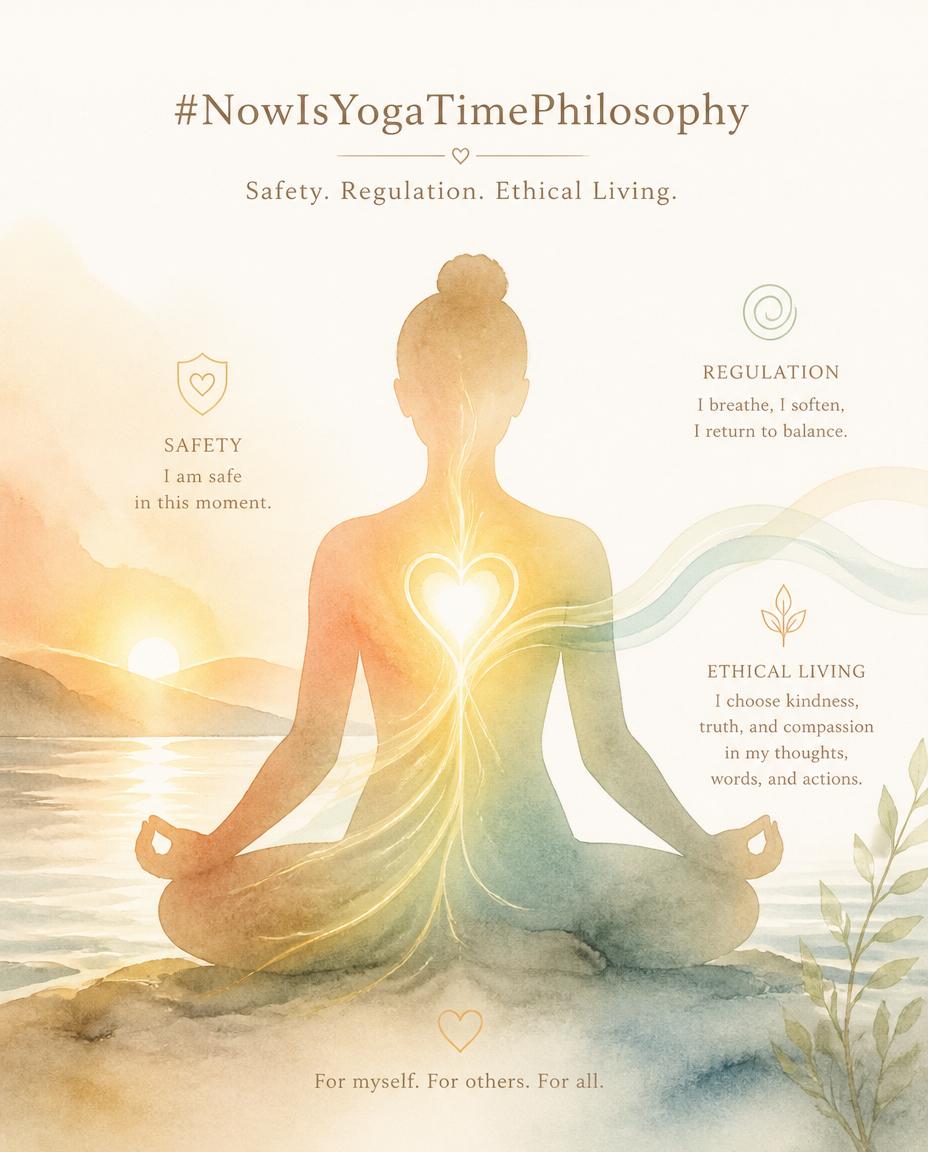
But when our outer life is aligned with our inner values — when we move through the world with honesty, care, and integrity — the nervous system settles. The body relaxes into itself. Presence becomes possible in a new way.
Yama is not only philosophy. It is the physiological foundation for a practice that actually works.
A Practice for Each Yama
Ahimsa: Today, notice the quality of your inner dialogue. Is it kind? Choose one moment to respond to yourself with the same gentleness you would offer a dear friend.
Satya: Notice one place in your life where you are not fully honest — with yourself or another. You don't need to act immediately. Just see it clearly.
Asteya: Choose one area where you consume more than you need — time, food, attention, resources. Not to punish yourself. Just to become aware.
Brahmacharya: Trace where your energy went today. What nourished you? What drained you? What was unnecessary? Let this awareness guide tomorrow.
Aparigraha: Identify one thing you are holding too tightly — an outcome, an identity, a relationship's shape. Breathe. And practice, just for today, holding it a little more lightly.
Conclusion
Yama is the beginning.
Not because it is the easiest — it is often the most challenging work in a practitioner's life. But because without it, everything that follows rests on unstable ground.
These five principles are not rules imposed from outside. They are invitations from within — toward a way of living that is more honest, more gentle, more awake.
When we practice Yama, we are not trying to become perfect. We are choosing, again and again, to live with a little more care. A little more truth. A little more presence.
This is the beginning of yoga.
Not the first pose. The first honest choice.
Return to these principles as often as you need. They will always be waiting — patient, steady, and true.
A Moment with the Yamas — Mini Practice
Find stillness. Close your eyes.
Bring each Yama to mind, one by one. For each one, ask yourself a single question — and simply listen.
Ahimsa: Where can I be more gentle today? (Breathe.)
Satya: Where am I not fully honest with myself? (Breathe.)
Asteya: What am I taking that isn't truly mine? (Breathe.)
Brahmacharya: Where is my energy going — and is that where I truly want it to go? (Breathe.)
Aparigraha: What am I holding too tightly? (Breathe.)
You don't need to answer these questions fully. Just the willingness to ask them — that is already the practice.

Yama → Niyama